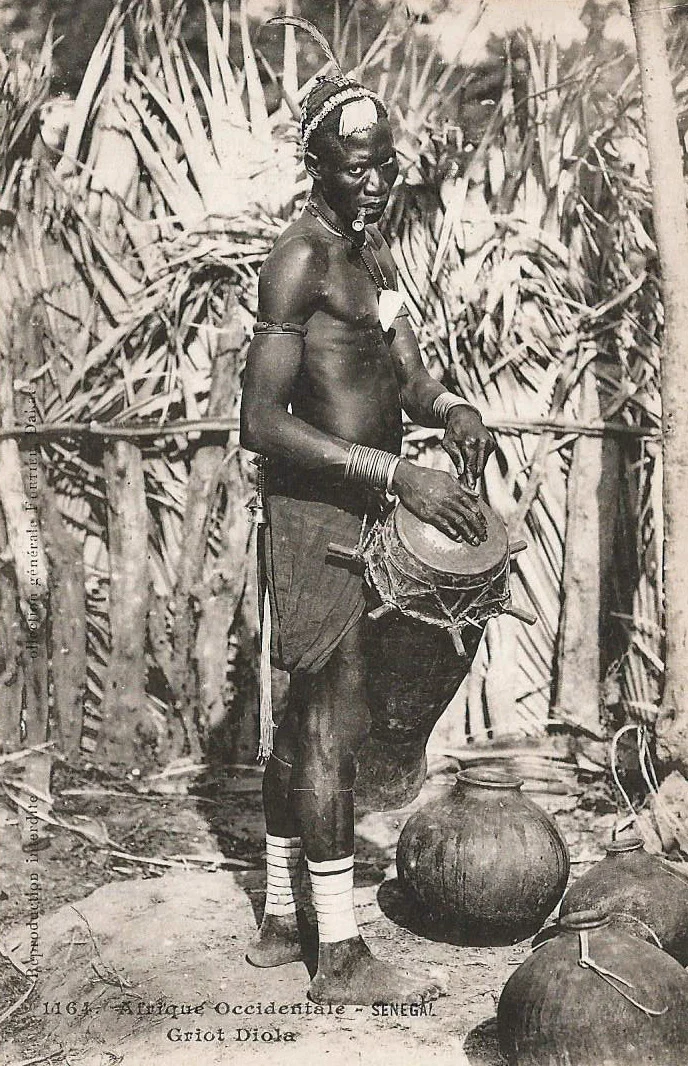
A digitised Senegalese postcard carries the printed description “Griot Diola” beneath a portrait of a man holding a drum. The image record names the photographer, François-Edmond Fortier, and dates the postcard to the early twentieth century. It supplies no personal name for the sitter. The photograph preserves a visual encounter and a publisher’s classification together. Those two layers create different kinds of evidence for a reader approaching African cultural history. [6]
The distinction opens a wider question about who decides how knowledge becomes visible and usable. Language institutions, heritage conventions and community protocols assign responsibilities for creating and circulating cultural records. Reading their mechanisms together shows that digital access also involves authority over naming, interpretation and future use. Each instrument addresses a particular setting and group of rights-holders. [1] [2] [3] [4] [5]
ACALAN traces its origins to Mali’s Mission for the African Academy of Languages, established by presidential decree on 19 December 2000 under Alpha Oumar Konaré. In January 2006, the AU Assembly approved statutes transforming that mission into a specialised AU institution, headquartered in Bamako. Its documented purposes include African languages in education, cooperation between states and cross-border language initiatives. This institutional history records African political action in the organisation of knowledge. [1]
The cross-border remit matters because a language’s speakers and uses can extend across state jurisdictions. Schools, public institutions and digital systems make decisions about which languages people can use to learn and participate. ACALAN’s mandate places language development within cooperation among African states and the use of African languages across social life. A mandate establishes an institutional purpose; the educational effects of a particular programme require evidence of its implementation. [1]
UNESCO’s October 2003 Recommendation on multilingualism in cyberspace calls for resources for local-language content, multilingual systems and the skills required to create digital material. It also addresses affordable access, rural communities and public institutions such as libraries and schools. Its provisions connect the language of information with the practical means of reaching it. The document is a recommendation to member states, whose application requires action through relevant institutions and policies. [2]
This framework gives a concrete meaning to exclusion: people can encounter a language barrier, a connection cost, an inaccessible interface or a lack of relevant material. Each condition calls for a different intervention and a different measure of progress. The recommendation’s treatment of government-held records also preserves privacy, confidentiality and applicable intellectual-property interests. Public availability therefore requires attention to the record and the conditions of its use. [2]
UNESCO adopted the Convention for the Safeguarding of the Intangible Cultural Heritage two days later, on 17 October 2003. Article 2 includes oral traditions, performance and knowledge among heritage domains and recognises their continued recreation by communities. Article 13 addresses access while respecting customary practices governing particular aspects of heritage. Article 15 asks states parties to involve the people who create, maintain and transmit it in its management. [3]
These provisions locate responsibility in ongoing social relationships. A recorded performance may enter an archive, while transmission continues through teaching, participation and community use. A safeguarding arrangement therefore needs decisions about documentation and about the conditions that sustain the practice. The convention’s human-rights and mutual-respect requirements also matter within communities: the label of heritage cannot settle every question about whose interests a practice serves. [3]
The 2020 CARE paper by Stephanie Russo Carroll and co-authors describes an Indigenous-led workshop during International Data Week in Gaborone, Botswana, in November 2018. Its principles address collective benefit, authority to control, responsibility and ethics. The authors connect Indigenous data’s collection and reuse to self-determination and to the people whose lands, cultures and lives it concerns. These principles supply a governance framework. [4]
The relevant unit is the specific people or community with interests and authority in the data. Applying that framework in Africa requires identifying those relationships in each case. African nationality alone establishes neither Indigenous status nor collective permission. The paper directs attention to who sets protocols, receives benefits and assesses risks throughout a record’s life, extending responsibility to later reuse. [4]
Local Contexts’ Traditional Knowledge Labels offer a documented means for communities to communicate conditions attached to circulating cultural material. Its provenance labels identify cultural authority or interests; protocol labels address matters such as sensitive or seasonal material; permission labels describe approved uses. The project’s own guidance situates these labels within community governance and relationships with institutions holding records. They convey information about responsibilities that a digital catalogue might otherwise omit. [5]
The mechanism is specific: information about a material’s community relationships accompanies the digital object and can remain visible to later users. A label is therefore part of description and interpretation, alongside the creator, date and source. Its presence does not automatically resolve a legal ownership dispute, and a researcher cannot assign a community’s permission by inference. Local Contexts describes participation and community-specific protocols as the basis for the information carried by its labels. [5]
Return to the Senegalese postcard. The creator’s name and printed classification are preserved, while the sitter’s personal identity and account are absent from the available record. A reader can study the visual composition, publication format and caption as features of the object. Those features also disclose the asymmetry of its documentation: the person represented has not supplied an identifiable voice in this record. His thoughts, consent and exact social role cannot be recovered from the caption alone. [6]
The policy documents and governance frameworks give different ways of addressing that asymmetry in newly created records. Language access supports people’s ability to contribute; heritage participation locates communities within management; CARE and Local Contexts address decisions about use and future circulation. The shared issue is the distribution of authority at identifiable stages of knowledge production. The mechanisms retain their distinct purposes, and their application must be demonstrated in the particular archive or project being studied. [2] [3] [4] [5]
African agency in knowledge institutions can be followed through the Mali initiative that became ACALAN and through the documented development of community-centred data-governance principles in Botswana. The historical postcard adds a practical reminder of what an inherited description records and what it leaves unidentified. A critical research practice connects access to responsibilities over language, attribution, interpretation and use. It makes the people and institutions holding those responsibilities visible in the record itself. [1] [4] [6]
- [1]African Academy of Languages (ACALAN). Who We Are: institutional history and language mandateUndated institutional page; consulted 12 October 2026
- [2]UNESCO. Recommendation concerning the Promotion and Use of Multilingualism and Universal Access to CyberspaceAdopted 15 October 2003
- [3]UNESCO. Convention for the Safeguarding of the Intangible Cultural Heritage, especially Articles 2, 13 and 15Adopted 17 October 2003
- [4]Stephanie Russo Carroll and co-authors / Data Science Journal. The CARE Principles for Indigenous Data Governance4 November 2020; DOI 10.5334/dsj-2020-043
- [5]Local Contexts. Traditional Knowledge Labels: provenance, protocols and permissionsUndated project documentation; consulted 12 October 2026
- [6]François-Edmond Fortier / Wikimedia Commons image record. Sénégal-Griot Diola (AOF): historical postcard and provenanceEarly twentieth century; exact date unknown; file uploaded 2018
Did this publication help you understand the topic?
0 voluntary responses. Browser-based participation; responses are not a representative survey.
We welcome suggestions, contributions and recommendations.
Editorial standards ↗