On 5 November 2026 in Lagos, Nigeria’s National Commission for Museums and Monuments signed for the transfer of ownership of 39 objects from the historic Kingdom of Benin. The agreement with Sweden’s National Museums of World Culture also put six of those objects on a ten-year loan to the Swedish museums. The objects had left the kingdom after British troops sacked Benin City in 1897. The Lagos signing changes who holds title. It also brings into view decisions that a transfer of title cannot settle on its own: where particular objects will be kept, who can see or study them, and how the people for whom they have living significance can shape their care. [3] [7] [8]
Sweden’s government gave its museums permission to return the objects in November 2023. By then the museum agency had asked for authorisation and traced the pieces in its own collections to the 1897 plunder. The government’s announcement left the transfer and handover to the museum agency. The museum, in turn, said it acted in response to the Nigerian commission’s support for recovering the objects. The three years between the government decision and the signing show what each record can tell us: the first allowed the transfer, while the agreement in Lagos put it into effect. [7] [9] [12]
Olugbile Holloway signed for the Nigerian commission and Britta Söderqvist for the Swedish museums. The Swedish museum says the commission has an arrangement with the royal court in Benin City to receive objects that are returned. It describes pieces cast in copper alloy and others worked in ivory or wood. The common label “Benin Bronzes” can obscure these differences: the pieces are the products of different kinds of skilled work, and their significance may vary with how they were made and used. The museum’s announcement establishes the transfer and the number loaned back. It does not specify a display schedule in Nigeria for individual works. [1] [2] [7] [8]
For visitors in Sweden, the loan means some of the collection can remain available locally even after the museum has given up ownership. For a student or artist in Edo State, the new ownership may eventually allow an encounter with works long held abroad, but that depends on where each piece is taken and on the arrangements for viewing or study. The same distinctions matter to the royal court, which is concerned with objects that may have customary or ritual significance. A loan of six pieces is evidence of an agreed location for those pieces during the loan; it does not establish the destination, display conditions or treatment of the other thirty-three. [2] [3] [7] [8]
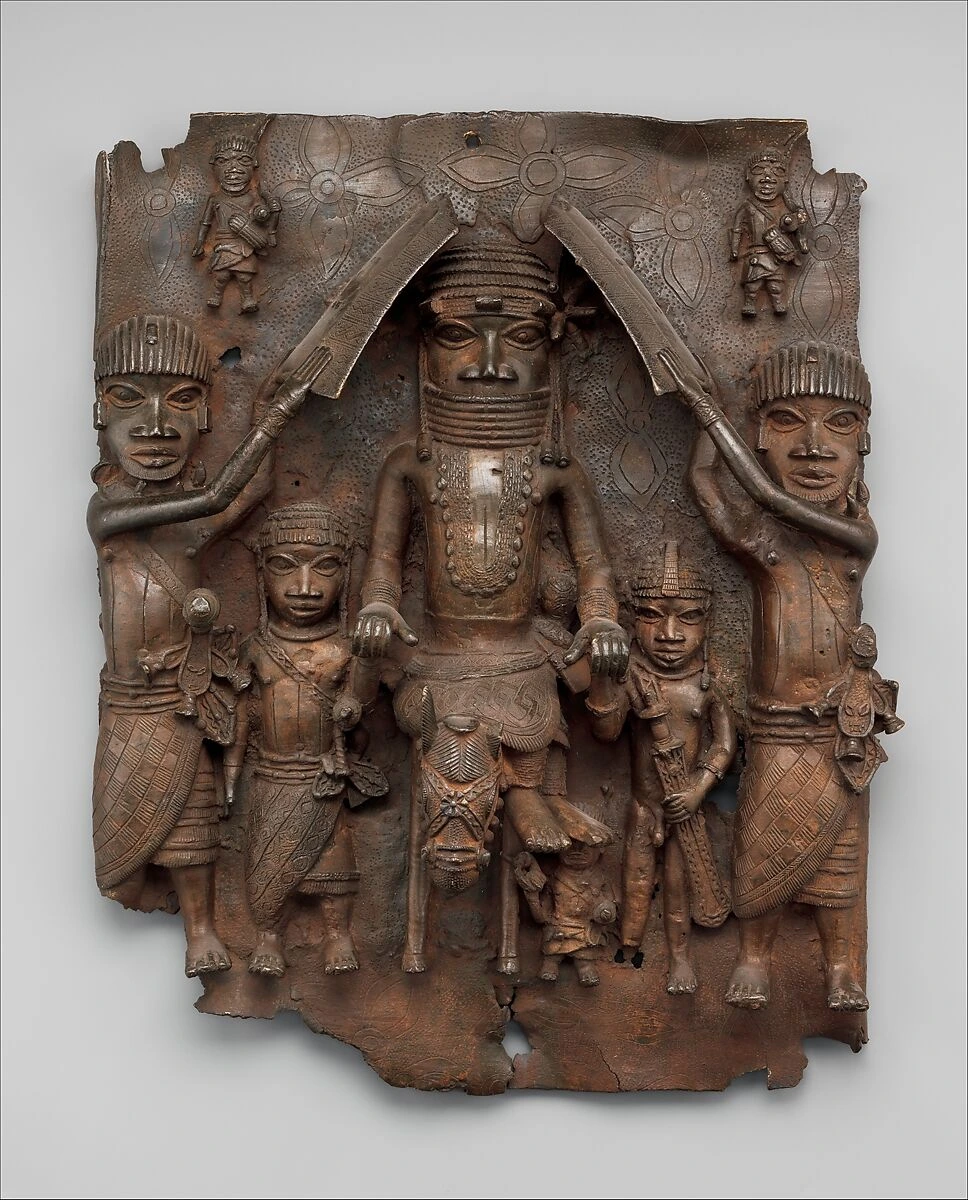
The Metropolitan Museum attributes the mounted king’s plaque to artists of the Ìgùn Ẹ́rọ̀nwwọ̀n brass-casting guild. It identifies brass as the material and the Court of Benin, in present-day Nigeria, as the place of production. The central figure’s scale and surrounding attendants communicate relative status. These were skilled decisions about how authority should appear within a palace environment; the object’s date places that visual language well before the 1897 conquest. [1]
A second plaque, held by the Cleveland Museum of Art and dated to the sixteenth or seventeenth century, shows two attendants supporting an ọ́bà. The museum explains how scale, clothing and jewellery establish hierarchy. It also identifies designs along the narrow edges as possible signatures of individual casters. Reading the centre and the edges together makes both office and workmanship relevant: a royal image depended on the knowledge and labour of identifiable artistic specialists. [6]
The Cleveland record identifies an earlier British Museum number on its plaque. It states that the object entered that collection in 1898 after British troops took it from a palace storeroom in 1897. The number is therefore evidence of an institutional stage in the object’s movement. A careful provenance account follows such stages: removal, entry into a collection and subsequent transfer. Each stage needs its own documentation, even when the wider history of conquest is established. [6]
Legal scholar L. Amede Obiora locates the dispersal of Benin art within the attack on the kingdom and the displacement of royal authority. Her 2025 study examines archival records, correspondence and public debate to connect restitution with the standing of traditional institutions. That approach gives the seizure a political setting. Palace objects belonged to relationships of ritual responsibility and governance, while their removal placed decisions about their interpretation and circulation in other institutions. [3]
Artist and art historian Peju Layiwola’s 2014 article examines creative responses to 1897, including her own installations and works by other Nigerian artists. Her installation 1897.com used 1,000 terracotta heads to evoke the dispersal of palace treasures. She explicitly noted uncertainty about the exact total removed. The installation’s repeated forms make loss perceptible through an artistic arrangement; its figure of 1,000 is part of that composition and should not become an inventory of the looted collection. [2]
Layiwola also describes Theatre of War, an assemblage of terracotta tablets adapting commands and accounts from British parliamentary papers. Moving administrative language into a material artwork brings the documentary record into public memory. Readers can distinguish the original dispatches, the artist’s selection and the installation’s interpretation. That sequence shows how contemporary cultural production participates in historical argument and makes the archive available for scrutiny through another medium. [2]
On 25 August 2022, the Stiftung Preußischer Kulturbesitz reported signing an ownership transfer with Nigeria’s National Commission for Museums and Monuments. The published agreement says title passed at signing without payment, and divides the objects between those to be physically returned and those to remain on loan. The release’s headline and text give different totals, 514 and 512. The available copy of the agreement identifies the two inventories but does not reproduce their itemised contents, so neither figure can be resolved from that copy. [4] [11]
The Berlin agreement gives the institution a ten-year loan with a renewal and notice procedure. It also sets conditions for public access, credits the Nigerian commission as lender in displays and provides for sharing research results and images. The Berlin foundation agrees to cover packing and shipping to a location in Nigeria chosen by the Nigerian side under the terms of the contract. These provisions show what can be agreed beyond a change of title: who pays for a move, who gets access to research and how the public is told whose objects it is seeing. The Swedish announcement establishes the duration and number of loans in its own agreement, but it does not establish that those further terms are the same. [7] [11]
The University of Zurich’s release of 20 March 2026 records a Nigerian claim submitted in March 2024 for fourteen Benin objects. It then announces the university’s decision to honour that claim and describes provenance research conducted with Nigerian partners. The release identifies research as part of the process that informed the decision. It also provides a traceable sequence in which a requesting institution, a holding institution and specific objects can be distinguished. [5]
The March announcement projected delivery in the summer. The later Swiss record supplies the missing step: on 29 June, the Nigerian commission formally received eighteen Benin objects at the National Museum in Lagos, including all fourteen from the University of Zurich and two each from museums in Zurich and Geneva. The Swiss account says twenty-eight objects changed ownership in March across the three collections, with ten remaining in Switzerland on loan. Eighteen is therefore a count of the Benin objects received in Lagos, while twenty-eight is the count covered by the transfer of title. The same ceremony included separate Nigerian objects recovered in criminal proceedings; those do not belong in either Benin total. [5] [10]
The Swiss authorities said some of the returned objects would go on display in Lagos and that most would be stored temporarily at the National Museum in Benin City. Their account also described plans for a gallery. Those plans matter because receiving a consignment and making it available to people require different work. A collection in storage can be safeguarded while a venue is prepared; the act of storing it does not establish public opening hours, research access or a role for Edo communities in interpreting it. The published Swiss and Swedish records establish different stages in these arrangements. [3] [7] [10]
Obiora connects the ọ́bà’s cultural authority to obligations towards the community. She interprets custodianship through shared benefit and responsibility, relating returned objects to customary institutions and the modern Nigerian state. This scholarly interpretation directs attention to participation in preserving, studying and encountering heritage, and to the exercise of authority through which custodial responsibilities acquire practical form. [3]
Layiwola’s work makes a further claim on how these decisions are understood. Her installations work with memories of the palace and the dispersal of its objects, rather than relying on the display of the originals. That does not remove the need to return the objects. It shows why public benefit includes the means to make and contest interpretations, whether through artworks, conservation research or records that follow an individual object across collections. A transfer agreement can redistribute control over objects and images; community access also depends on the choices Nigerian institutions make about places, documentation and who gets to tell the story. [2] [3] [11]
The Lagos transfer ends Swedish ownership of the 39 objects while keeping six in Sweden under a loan. The Swiss handover shows how a later record can establish which objects actually arrived, and the Berlin agreement shows how much else can be set in writing. The decisions that follow are about more than the objects’ location. They will shape how students, artists, researchers and communities connected to the court can encounter them, learn from them and take part in deciding how they are cared for. [2] [3] [7] [10] [11]
- [1]The Metropolitan Museum of Art. Plaque with equestrian ọ́bà (king) and attendants, 1978.412.309ca. 1540–70; undated catalogue, consulted 2026-10-18
- [2]Peju Layiwola / Open Arts Journal. Making meaning from a fragmented past: 1897 and the creative processSummer 2014, issue 3, pp. 85–96
- [3]L. Amede Obiora / The Journal of African History. Traditional Institutions and Cultural Heritage Law: The Case of Benin Bronzes2025-10-14
- [4]Stiftung Preußischer Kulturbesitz. 514 Berlin Benin bronzes return to Nigerian ownership2022-08-25
- [5]University of Zurich. UZH Returns Benin Bronzes From Its Ethnographic Museum to Nigeria2026-03-20
- [6]Cleveland Museum of Art. Plaque, 1999.11500s–1600s; undated catalogue, consulted 2026-10-18
- [7]National Museums of World Culture, Sweden. Beninföremål tillbaka i Nigeria5 November 2026
- [8]The Art Newspaper. Swedish museums restitute objects to Nigeria and Bolivia9 November 2026; original interview with Swedish museum curator
- [9]Ministry of Culture, Sweden. Statens museer för världskultur får återlämna kulturarvsföremål till Bolivia och Nigeria16 November 2023
- [10]Swiss Federal Office of Culture. Restitution to Nigeria: Swiss museums return 18 major artefacts29 June 2026
- [11]Stiftung Preußischer Kulturbesitz and National Commission for Museums and Monuments, Nigeria. Agreement on the transfer of ownership and return of Benin Bronzes25 August 2022; public copy
- [12]National Museums of World Culture, Sweden. Världskulturmuseerna får återlämna Beninföremål till NigeriaUndated; discusses 16 November 2023 authorisation; accessed 12 November 2026
Did this publication help you understand the topic?
0 voluntary responses. Browser-based participation; responses are not a representative survey.
We welcome suggestions, contributions and recommendations.
Editorial standards ↗