At Cairo in July 1964, the OAU Assembly pledged respect for borders as they stood at national independence. The decision raises a precise historical question: how did governments connect territorial sovereignty to the wider project of African unity? Reading the 1963 founding documents, the Cairo resolution and later AU instruments reveals an institutional sequence linking independent states, liberation movements and cooperation among neighbouring populations. [1][2][3][5]
The OAU Charter, signed on 25 May 1963, made sovereign equality and territorial integrity organising principles. Its purposes also included ending colonial domination and coordinating policies for people’s wellbeing. Political, economic, educational and defence cooperation appeared in the same institutional text. The relationship matters: independence supplied governments with a recognised position from which to participate in collective institutions. Cooperation was written into the organisation of that independence. [1]
The charter established an assembly, ministers’ council, secretariat and commission for mediation, conciliation and arbitration. Each member state held one assembly vote. These arrangements placed governments at the centre of continental decisions and specified peaceful methods of settling disputes. The text supplies evidence of institutional design and of where authority was located. It also identifies the organisations whose subsequent records would be needed to follow particular negotiations from a commitment into a decision. [1]
Resolution AHG/Res.16(I), adopted during the 17–21 July 1964 session, treated the borders inherited at independence as an existing political reality and border disputes as a source of division. Its operative commitment was respect for those borders, alongside the charter’s territorial-integrity principle. Independent African governments made this collective rule through their own organisation. That subsequent institutional choice is a distinct stage in the history of boundaries whose origins often lay in colonial rule. [2]
The resolution sought peaceful settlement within an African framework. Its text establishes neither the legal alignment of every local boundary nor a universal right of passage for border residents. A concrete dispute still required its own process. The same Cairo collection recommended direct Ghana–Upper Volta discussions toward a mutually acceptable settlement. Placing that recommendation beside the general pledge shows the different scales of institutional work: a continental principle and a negotiated response to a particular disagreement. [2]
The Addis Ababa resolutions of May 1963 connected independent governments to territories still under colonial domination. They created a nine-state coordinating committee, headquartered in Dar-es-Salaam in then Tanganyika, to harmonise assistance and administer a special fund. Voluntary state contributions were the stated funding mechanism. These clauses identify an organisational channel, a location and a financing proposal. They document the authorisation of assistance; expenditure and its effects would have to be traced through the committee’s financial and operational records. [3]
The same documents supported South-West Africa’s self-determination and independence and proposed cooperation on transport and economic planning. Continental solidarity thus had several institutional forms: diplomatic positions, coordinated material support and plans for connection among economies. The sequence makes African agency specific. Governments adopted instruments, assigned functions and named bodies responsible for work. Such documentary detail permits scrutiny of an institution’s decisions without assuming that a declaration by itself produced the intended result. [3]
The Constitutive Act adopted in Lomé on 11 July 2000 retained respect for borders at independence and peaceful resolution of interstate conflicts. Its principles also included popular participation, gender equality, democratic government and human rights. Reading those provisions together locates sovereignty within an institutional text containing responsibilities toward people. The continuity of the boundary rule sits within a wider statement of what the continental organisation was intended to protect and promote. [4]
Article 4(h) provides for Union intervention following an Assembly decision in the grave circumstances it specifies: war crimes, genocide and crimes against humanity. The clause assigns a collective institutional power and a decision-maker. It does not establish that intervention occurred in any particular case. The act also condemns unconstitutional changes of government. Together these provisions supply documentary grounds for studying the relationship between territorial independence, legitimate authority and continental responsibility through decisions and implementation records. [4]
The Niamey Convention, adopted on 27 June 2014, defines cross-border cooperation around relations among populations, territorial communities, administrations and other stakeholders across states. Its objectives include agreed demarcation, peaceful dispute settlement and integrated management. Article 3 identifies activities ranging from mapping and transport to water, education, culture and security. The boundary becomes a location where several public authorities and social needs meet. [5]
The convention names national focal authorities and provides for domestic legal frameworks, policy integration and reports every two years by states parties. It envisages local authorities acting within domestic law. The adopted text records institutional design; it does not establish present ratification or implementation in every country. [5]
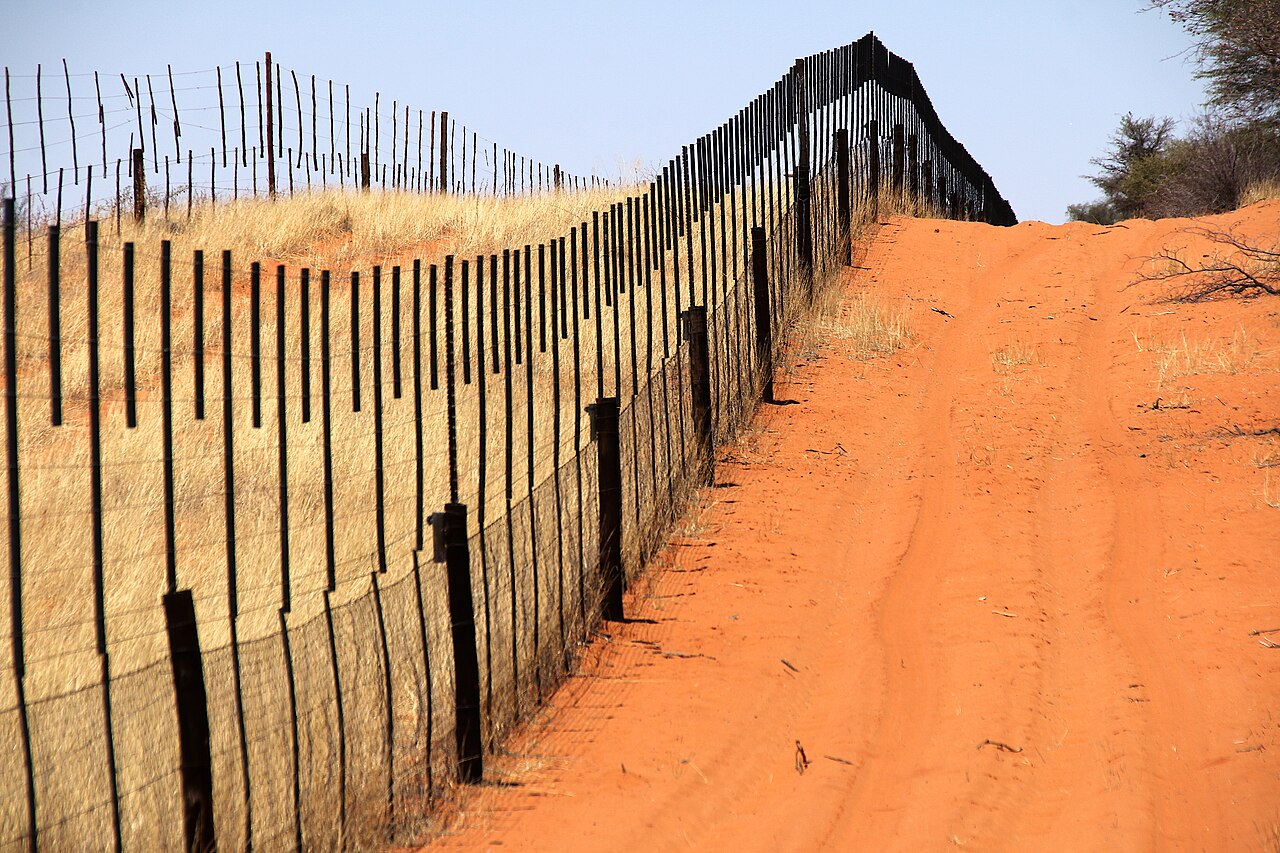
Hp.Baumeler’s photograph of 19 October 2018 records a fence along the Namibia–Botswana boundary: wire and stakes run through a dry landscape beside tracks. Its dated viewpoint supplies visual evidence of one physical border setting. The image cannot determine the line’s legal alignment, its construction history, crossing rules or residents’ experiences. Those questions require maps, administrative records and testimony from the people involved. The photograph makes the physical object available for examination while preserving those distinctions. [6]
Reading this visual record alongside the Niamey text brings the scale of border governance into view. A physical boundary is encountered locally, while cooperation is organised through communities, national authorities and regional bodies. The photograph documents one setting in 2018; the convention identifies institutions and activities through which neighbouring populations’ relations may be addressed. Keeping both dates and source types visible lets a historical account connect law, place and public administration without assigning the image an undocumented story. [5][6]
The documentary sequence shows sovereignty being organised through a border pledge, liberation machinery, collective responsibilities and cross-border cooperation. Each instrument identifies a different object of institutional action. Their relationship gives Pan-Africanism a history of concrete choices about authority, resources and relations among peoples, open to examination through the records those choices generated. [1][2][3][4][5]
- [1]Organisation of African Unity. OAU Charter1963-05-25
- [2]OAU Assembly. AHG/Res.16(I): Border Disputes among African States — Cairo resolutions1964-07-17–21
- [3]Summit Conference of Independent African States. Resolutions adopted in Addis Ababa, 22–25 May 19631963-05-22–25
- [4]African Union / African Commission on Human and Peoples’ Rights. Constitutive Act of the African UnionAdopted 2000-07-11
- [5]African Union. African Union Convention on Cross-Border Cooperation (Niamey Convention)Adopted 2014-06-27
- [6]Hp.Baumeler / Wikimedia Commons. Border fence Namibia Botswana (2018)Photographed 2018-10-19
Did this publication help you understand the topic?
0 voluntary responses. Browser-based participation; responses are not a representative survey.
We welcome suggestions, contributions and recommendations.
Editorial standards ↗