The 2009 proposal for encoding additional Bamum characters dates the script’s beginnings to around 1896 and credits Sultan Njoya and his scribes. It describes a corpus including histories, correspondence, cartography and illustrated folktales. This range makes writing part of a political and cultural world with several purposes. The archive preserves material through which authority could be recorded, knowledge organised and accounts of the past carried forward. [1]
The encoding proposal identifies successive phases of the script, ending in the modern form known as Phase G. Characters were removed, reassigned and reused as the system developed. A graphic form could acquire a different value in a later phase. Identifying the script’s phase helps establish how an older document should be read. Encoding supports the representation and identification of older forms. [1]
Charles Riley’s September 2006 report describes work at Foumban with palace representatives and the Bamum Scripts and Archives Project. His account records attention to manuscripts, fragments, pronunciation and the ordering of characters. The project’s local participants helped identify forms and discuss proposed spellings. Preservation involved people with practical knowledge of the script. Their expertise entered the processes through which handwritten records could be transcribed, described and represented in a digital system. [2]
The catalogue for History of the Bamum Kings: from Rifum to Njoya, Volume II identifies an extensive manuscript held in the palace archive. It lists 304 leaves and 604 pages, in Akauku Mfemfe script, and gives an approximate date of about 1912 with a question mark. Those measurements and qualifications establish the scale and dating status of the object. The catalogue describes a substantial historical work produced within the Bamum political world. [3]
Its royal subject and palace custody provide an important starting point for interpretation. A history organised around kings gives political succession a prominent place in the account of the past. Its preservation allows that account to remain available for study. Establishing how particular episodes were narrated requires reading the manuscript and its language. The catalogue supplies identification and provenance; it does not by itself establish how every group within the society understood royal rule. [3]
Another catalogue record identifies a decision by King Njoya concerning trade involving various individuals. It describes a single leaf, written in Akauku Nyiet script, carrying the palace seal. These attributes connect an administrative subject with a material means of authentication. The presence of a seal matters because an official document’s authority depends partly on how a decision is recognised as belonging to the institution that issues it. [4]
The record also contains a dating discrepancy: its title gives 31 March 1905, while its description gives 1917. That difference remains unresolved in the published entry. The document can be identified as a catalogued trade decision with a stated palace seal; its precise place in a timeline requires additional verification. Retaining both dates makes the evidential issue visible at the point where chronology would otherwise be inferred from a brief catalogue heading. [4]
A further record describes King Njoya announcing his travels to the Bamum people on 28 April 1922. The catalogue identifies one leaf with two pages, in Akauku Mfemfe script, and notes a seal and signature. Here, a royal announcement appears as a dated written object. Its combination of message, script and authentication connects the movement of a ruler to the administration of a political relationship with the people addressed. [5]
The entry provides a concrete basis for studying how royal communication was recorded. Its subject identifies a message directed to the Bamum people, while its physical description preserves the form in which that message survives. Questions about who received it, how it was circulated and how people responded require evidence of those activities. The surviving announcement is a point of entry into such research, with an identifiable date and a specified archival location. [5]
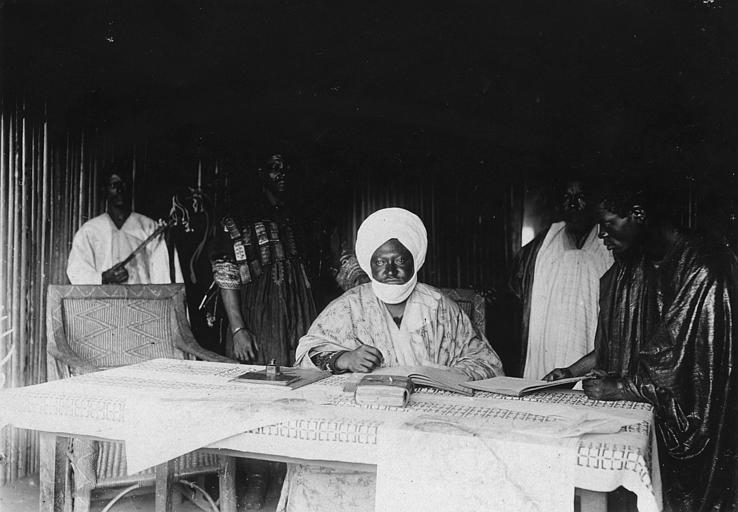
Frédéric Gadmer’s photograph places Njoya in his study at Foumban on 25 May 1917. The ruler sits at a table with an open book and a pen, surrounded by attendants. The French heritage catalogue supplies the date, creator and reference AP 62 T 121311. The image preserves a particular arrangement of people and writing materials within a royal workspace. Its visible book is not identified here as a particular manuscript, and its contents are not translated. [7]
Gadmer’s work belongs to the French military photographic collection. That provenance is part of the image’s historical meaning: a royal setting was recorded through an external institutional camera. Studying the frame includes attention to the scene it preserves, the photographer who made it and the archive through which it now circulates. The photograph’s dated setting helps locate a moment of documentation without turning the visible arrangement into evidence of every activity conducted at the palace. [7]
The Library of Congress’s historical guide lists work by Bamum authors and scholars alongside studies of colonial administration, religion and visual representation. Its entries include Njoya’s Histoire et coutumes, the collective Le peuple Bamum, and Aboubakar Njiasse Njoya’s study of nineteenth-century royal land policy. These are bibliographic pointers to different kinds of scholarship. Their presence makes the choice of whose work enters a reading list visible as part of the research process. [6]
Riley’s field report also records the practical labour of examining dimensions and condition, identifying older script forms and transcribing what could be read. This work connects preservation to interpretation through identifiable procedures. A record acquires a catalogue entry through decisions about its language, dating and description. Understanding those decisions helps readers follow how the evidence used in a historical argument has been made accessible and which expertise contributed to that process. [2]
Bamum’s royal archive brings local writing, political communication and historical narration into one field of study. Its records support a history built from identifiable African documents and the work of people who preserve and interpret them. Accurate description keeps the material object, its provenance and the argument drawn from it connected. [6]
- [1]Michael Everson, Charles Riley and Konrad Tuchscherer / Bamum palace project and UC Berkeley. Proposal for encoding additional Bamum characters in the SMP of the UCS28 March 2009
- [2]Charles Riley / Bamum Scripts and Archives Project. Report on work with the Bamum script in Cameroon21 September 2006; fieldwork August 2006
- [3]Bamum palace archive / British Library Endangered Archives Programme. EAP 051/1/3/3: History of the Bamum Kings, Volume IICirca 1912?; catalogue consulted 12 October 2026
- [4]Bamum palace archive / British Library Endangered Archives Programme. EAP 051/1/2/341: Decision by King Njoya concerning tradeTitle 31 March 1905; description 1917; discrepancy unresolved
- [5]Bamum palace archive / British Library Endangered Archives Programme. EAP 051/1/3/14: Record of King Njoya announcing his travels28 April 1922; catalogue consulted 12 October 2026
- [6]Library of Congress. Bamum Script: Historical and Sociopolitical ContextUpdated 13 August 2026; consulted 12 October 2026
- [7]Frédéric Gadmer / French Ministry of Culture / Wikimedia Commons. Njoya in his study, Foumban, AP 62 T 12131125 May 1917
Did this publication help you understand the topic?
0 voluntary responses. Browser-based participation; responses are not a representative survey.
We welcome suggestions, contributions and recommendations.
Editorial standards ↗