Namibia’s Communal Land Reform Act, published on 12 August 2002, places customary allocation within a chain of institutions. A chief or traditional authority makes the initial decision. Sections 24–25 require land-board ratification, registration and a certificate for the recognised right. Authority travels through that procedure and its records. [3]
This documentary review asks how that chain reshaped the relationship between customary leadership and the postcolonial state. The answer emerges from the placement of powers: a locally recognised decision, a statutory body’s scrutiny and a named person’s recorded right. Reading this arrangement alongside dated studies of women’s access shows why the administrative route matters to the distribution of land. [2] [3] [5]
Article 66 of Namibia’s Constitution preserved customary and common law existing at independence, subject to compatibility with the Constitution and legislation. Parliament could modify either. The constitutional settlement thus carried inherited legal forms into an order that subjected them to public rules. Equality under Article 10 and administrative justice under Article 18 supply standards through which the exercise of authority can be examined. This review uses the 2010 constitutional text identified in the source record. [1]
The Traditional Authorities Act of 2000 made customary leadership part of a documented statutory arrangement. Its section 3 includes responsibilities for customary law, cultural preservation and gender equality in leadership. Section 14 excludes discriminatory practices and constrains the influence of a leader’s political allegiance on official functions. Section 16 requires support for government, regional and local-council policies. Together, these clauses locate customary office within relationships to communities, constitutional rights and state institutions. [2]
Land scholar Wolfgang Werner’s 2015 review traces the negotiation behind the settlement. He reports that an earlier draft, influenced by Botswana’s land-board model, would have transferred communal-land authority away from traditional leaders. At a 1996 consultative workshop, traditional leaders opposed that proposal. The resulting 2002 arrangement retained their allocation role while adding boards responsible for registration and oversight. In Werner’s account, the law’s architecture emerged through organised African political participation. [4]
The chain distributes distinct tasks. A chief’s knowledge of community membership and an applicant’s claim can enter the process at allocation; board scrutiny and registration give that decision a further institutional form. Section 4’s original board composition included four women in specified categories. Such design choices make land governance a site where local legitimacy, ministerial appointment, representation and administrative records intersect. A statutory requirement establishes an obligation; the practice of particular boards requires its own documentary evidence. [2] [3]
UN Women and OHCHR’s 2013 handbook attributes a Namibia case study to Dianne Hubbard of the Legal Assistance Centre. It reports that, in ten villages under one board, 40% of land-right applications came from single, widowed or divorced women, whose average age was about 60. These figures refer to that local study; the handbook does not identify their fieldwork date. [5]
The case study describes a location where both the board and traditional authority encouraged women to apply. It also identifies barriers facing younger women. Age, marital status, household expectations and resources shaped who could convert a formally available right into an application. The documented variation locates access within local institutional practice and applicants’ social position, including barriers that can prevent entry into the application record. [5]
Namibia’s September 2018 Land Statistics Booklet assembled administrative records from the Ministry of Land Reform, Agribank and the Namibia Agricultural Union. Its methodology used sources with different reporting periods, including the 2012–2017 valuation roll and loan records through July 2018. The agency identifies missing variables and difficulties obtaining usable formats. The booklet is valuable evidence of the records assembled for that land debate; its figures retain those dates and definitions. [7]
The distinction between communal rights and freehold ownership is particularly important. A distribution calculated from commercial agricultural ownership cannot by itself describe access through customary allocation, use of communal grazing or an applicant’s ability to secure recognition. The booklet’s classifications direct the reader to the relevant population and tenure form. An argument about communal-land authority must match its measure to that process before interpreting an ownership percentage as evidence about it. [3] [7]
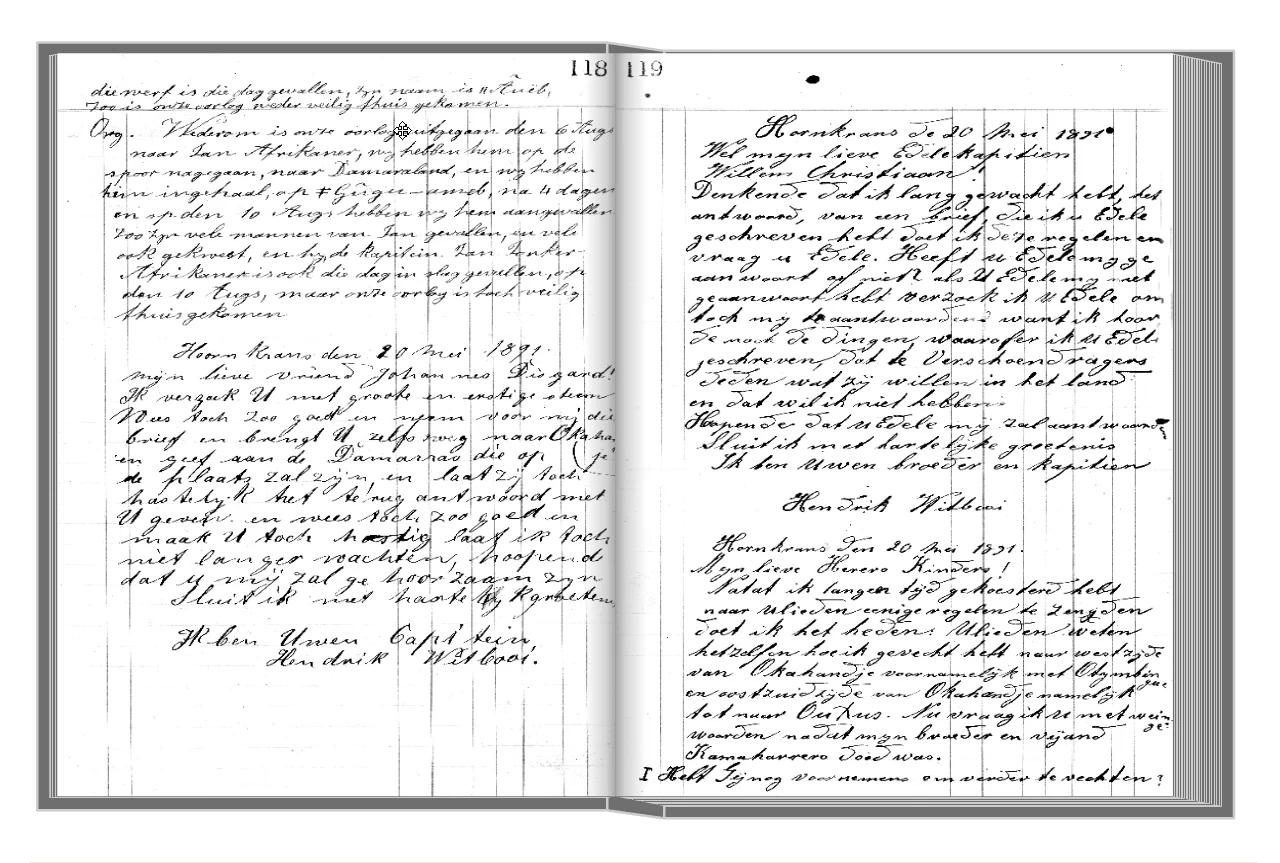
The manuscript reproduced with this essay is a different kind of record: folios 118–119 of Hendrik Witbooi’s letter journal, dated 20 May 1891. Its named African author and historical date identify a written source produced within Namibia’s political past. The image is included as an archival object. Establishing its language, addressees and circumstances would precede interpretation of a particular passage; the reproduced pages supply no evidence of a twentieth-century land-board decision. [8]
Werner’s assessment also draws attention to shared grazing and the relationship between registered individual claims and common resources. His 2015 discussion places registration within wider development policies and access to services and markets. Following that distinction prevents a certificate count from carrying an entire claim about livelihood improvement. Shared access, the use of rights and the material conditions of farming require separate evidence within the same land question. [4]
The Committee on World Food Security endorsed the Voluntary Guidelines on tenure in May 2012; the consulted edition is FAO’s May 2022 revision. These voluntary principles address secure and equitable access, including customary tenure. They provide a policy vocabulary for examining participation and responsibility while leaving the status of Namibia’s national legal provisions distinct. Their value here lies in connecting an institutional arrangement to the people whose access and livelihoods it governs. [6]
Taken together, the sources point to a precise research task: follow a claim through allocation, ratification, registration and subsequent use. Each stage produces different evidence and involves a different authority. Application records show entry into a process; decisions show institutional treatment; contextual research identifies barriers to entry. Comparing those sources can explain how a postcolonial settlement distributes recognition and how people exercise agency within it. [3] [5] [7]
Namibia’s settlement links customary allocation, statutory scrutiny and a written record. The dated research on women’s access identifies social conditions affecting the use of that route. Following office, procedure and recognition together explains how institutions and applicants participate in making land relations. Rights become usable through these relationships and through people’s ability to enter and navigate the process. [2] [3] [5] [6]
- [1]Republic of Namibia / WIPO Lex. Constitution of the Republic of Namibia, 1990 (2010 text), especially Articles 10, 18, 19 and 66Adopted 9 February 1990; text amended through 7 May 2010
- [2]Republic of Namibia / WIPO Lex. Traditional Authorities Act 25 of 2000, especially sections 3, 14 and 16Government Gazette, 22 December 2000
- [3]Republic of Namibia / FAOLEX. Communal Land Reform Act 5 of 2002, especially sections 4, 17 and 20–26Government Gazette 2787, 12 August 2002; original text
- [4]Wolfgang Werner / NUST, Integrated Land Management Institute. 25 years of land reform, ILMI Working Paper 1, especially pp. 12–142015
- [5]UN Women and OHCHR. Realizing Women’s Rights to Land and Other Productive Resources, pp. 18 and 222013; Namibia case study attributed to Dianne Hubbard, Legal Assistance Centre
- [6]FAO / Committee on World Food Security. Voluntary Guidelines on the Responsible Governance of Tenure, first revisionEndorsed 11 May 2012; revised edition May 2022
- [7]Namibia Statistics Agency. Namibia Land Statistics Booklet, especially pp. 12–14 and the land-tenure classificationsSeptember 2018; file hosted in 2024
- [8]Hendrik Witbooi / Digital Namibian Archive via Wikimedia Commons. Letter Journal No. 1, folios 118–119: digitised manuscript recordManuscript dated 20 May 1891; scan uploaded 17 February 2019
Did this publication help you understand the topic?
0 voluntary responses. Browser-based participation; responses are not a representative survey.
We welcome suggestions, contributions and recommendations.
Editorial standards ↗