Charles C. Stewart’s 2021 study examined inventories from 31 private libraries associated with SAVAMA-DCI. It investigated their contents and uses, directing attention to particular texts, their custodians and the historical periods represented by the collections. [1]
The Library of Congress’s Timbuktu exhibition identifies a poem teaching the rights of orphans and married women and another text explaining obligations in commercial exchanges. Its descriptions show verse being used to support memorisation. These are examples of scholarship addressing relationships between people: inheritance, lending, sales and responsibilities within households. Their presence in the Mamma Haidara collection places legal reasoning within the materials preserved by a named African library. [2]
The same catalogue identifies an astronomy teaching manuscript copied in 1733 and a work advising rulers about social justice and the protection of residents’ property. The descriptions establish the subjects of these particular records. Their rules and arguments are evidence of prescribed responsibilities; following their application requires additional records of decisions and disputes. These readings follow the catalogue’s English descriptions. [2]
The University of Cape Town’s profile of the al-Wangari library traces its origins to the collection of the sixteenth-century scholar Muhammad Baghayogho. It describes manuscripts later dispersed among family members in Djenné, Goundam and Timbuktu. Mukhtar bin Yayha al-Wangari’s efforts to gather them involved oral testimony, written documentation and meetings with relatives. The library’s modern reconstitution therefore depended on family knowledge and the work of identifying records across several places. [3]
The profile dates the library’s official opening to 26 September 2003 and describes approximately 3,000 manuscripts, including works by scholars from the region and Morocco. Its oldest dated item is identified as copied Qur’anic passages from 1695. A library’s sixteenth-century foundation, a surviving seventeenth-century copy and a modern opening date describe different moments. Preserving all three helps readers follow the continuity and reorganisation of custodianship without assigning every surviving object to the collection’s earliest period. [3]
A research project at Hamburg’s Centre for the Study of Manuscript Cultures examines scribes and copying practices across Middle Niger collections. Its design distinguishes professional copyists, students and scholars, and asks how their work can be identified through manuscripts and oral testimony. Marginal notes, interlinear explanations and patterns of copying become evidence for the transmission of learning. The project presents these as questions and methods guiding research, with specific findings requiring their own published evidence. [4]
The project also attends to pens, inks, covers, satchels and decoration. These materials connect a written text to the practical conditions of its production. A page involved choices about layout, handwriting, annotation and the handling of the book. Examining those choices makes skilled labour visible within intellectual history. The geographical scope extends across Timbuktu, Djenné and Ségou, preserving the relationships among several manuscript centres and the distinct collection histories through which their records became accessible. [4]
Cape Town’s Tombouctou Manuscripts Project describes a research programme concerned with legal and social history, scholarly elites, book collecting and reading. In January 2004 it digitised an initial selection of 100 legal manuscripts at the Mamma Haidara library; another 60 manuscripts from the Ahmed Baba collection followed. Selected texts became workbooks for detailed study and English translation. These are documented steps connecting image capture to interpretation within a particular scholarly project. [5]
The project’s account identifies the circulation of scholars and ideas alongside the economy of manuscript books. Its research design treats a collection as part of a social world involving teaching, copying, exchange and preservation. Close study of selected material supports claims about those texts and their contexts. A digitisation total identifies the scale of a recording activity; the manuscripts selected, the questions posed and the readings produced explain what knowledge the activity actually generated. [5]
Stewart’s analysis distinguishes the inventories he studied from earlier catalogues that privileged recognised authors and established scholarly works. Short study sheets, letters and unattributed writing acquired greater visibility in the SAVAMA-DCI inventories. He reports that one- and two-page items form a large share of these records. This changes the research agenda: ordinary written practices and the terms used by local cataloguers become important evidence alongside named compositions. The study’s observations concern its specified inventory sample. [1]
The British Library’s Endangered Libraries in Timbuktu project, awarded in 2017, focused on collections that had remained in the town during the crisis. Its description identifies cooperation with HMML and support for local workers. It also records an unresolved outcome: the metadata supplied to EAP did not match the images, preventing that programme from making the material available through its site. The record therefore preserves both a preservation initiative and a concrete problem in documentary access. [6]
That EAP outcome shows why an image’s relationship to its description matters. A researcher needs to know which library, manuscript and page a reproduction represents. The project record directs readers to HMML for some available material, while keeping its own access problem visible. This is a practical issue in the chain linking custodians, digital files, catalogue descriptions and historical arguments. Matching these elements makes it possible for another reader to identify the record being discussed. [6]
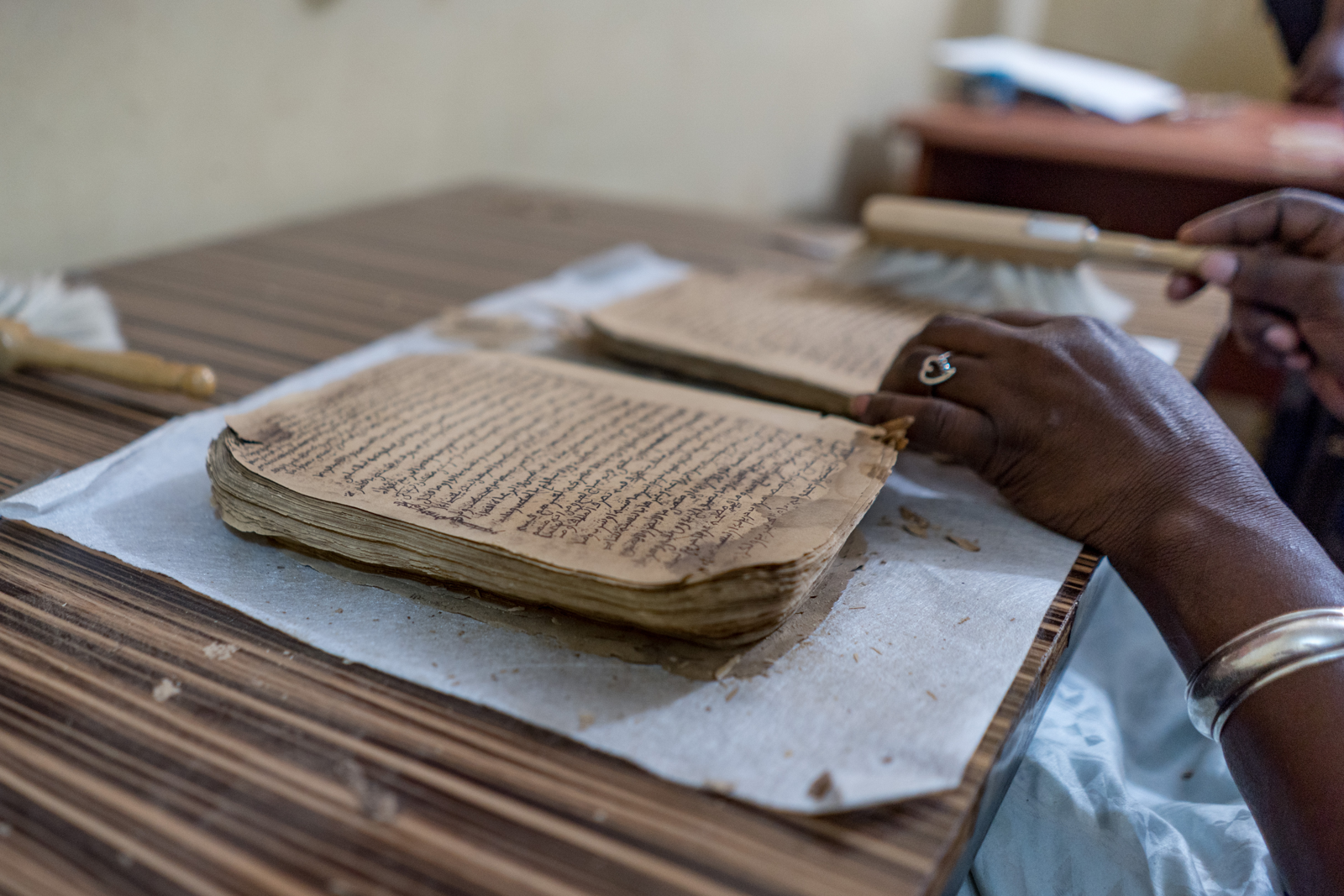
Mark Fischer’s photograph accompanying this essay shows gloved hands cleaning a manuscript at SAVAMA-DCI in Bamako on 8 August 2019. Its dated source identifies the preservation activity and the organisation. The individual manuscript’s title and historical date are unspecified. The image records material care at that moment: a written object had to be handled and preserved for its text to remain available. The photographer’s CC BY-SA 2.0 licence is retained with the reproduction. [7]
These collections support histories of learning through identifiable objects and the people who preserved, described and used them. Following collection histories and catalogue choices makes the social life of writing accessible while keeping the evidential scope of each record clear. [1]
- [1]Charles C. Stewart / History in Africa. What’s In the Manuscripts of Timbuktu? A Survey of the Contents of 31 Private Libraries20 May 2021
- [2]Library of Congress. Ancient Manuscripts from the Desert Libraries of Timbuktu—selected exhibition item descriptions2003 exhibition; manuscript dates identified individually
- [3]Tombouctou Manuscripts Project, University of Cape Town. al-Wangari Manuscript LibraryUndated profile; consulted 15 October 2026
- [4]Centre for the Study of Manuscript Cultures, University of Hamburg. Scribes and Scribal Practices in the Timbuktu Archive—research projectUndated research design; consulted 15 October 2026
- [5]Tombouctou Manuscripts Project, University of Cape Town. Project—research programme and manuscript studyUndated project account; 2004 activities; consulted 15 October 2026
- [6]British Library, Endangered Archives Programme. Endangered Libraries In Timbuktu (EAP1094)—aims and outcomesAward 2017; live outcome record consulted 15 October 2026
- [7]Mark Fischer. Timbuktu Manuscript—photograph and original rights recordPhotographed 8 August 2019; uploaded 12 August 2019
Did this publication help you understand the topic?
0 voluntary responses. Browser-based participation; responses are not a representative survey.
We welcome suggestions, contributions and recommendations.
Editorial standards ↗