On 26 April 1861, Muhammad al-Sadiq Bey adopted a constitution for the Regency of Tunis. It defined duties for the ruler, ministries, councils, courts and the management of revenue. Tania Abbiate’s history identifies a charter granted by the ruler. Examining access to these institutions reveals the political relationship organised by its design. [6]
The Fundamental Pact of 10 September 1857 promised security for people, their honour and their property across religious and linguistic differences. Its principles addressed taxation, military recruitment, commerce and the treatment of non-Muslim inhabitants. These provisions placed questions of everyday protection within a statement of the ruler’s responsibilities. For a resident facing taxation or a legal dispute, the promise concerned the terms under which government could exercise authority over a person. [2]
The pact’s introductory language located the ruler’s obligations within divine justice. Its closing commitments bound successors to an oath of observance and required senior officials to support the reforms. This combination made religion, public duty and administrative conduct part of the same political undertaking. A written promise could specify the conduct expected of those who governed, while its implementation depended on offices and procedures through which that conduct would be assessed. [2]
Hédia Khadhar’s study places these documents within the reform activity of the mid-nineteenth-century Regency. She traces connections to the Ottoman Tanzimat and to diplomatic pressure from France and Britain. In the correspondence she examines, Muhammad Bey described his intention to adapt Ottoman reforms to local circumstances. The constitutional episode therefore developed through exchanges among Tunisian rulers, advisers and external powers whose commercial and political interests reached into the Regency. [3]
Khadhar compares recurring vocabulary in documents associated with the pact with language in the 1789 Declaration of the Rights of Man and of the Citizen. She treats the similarities as evidence of possible influence. Her formulation makes the historical relationship a subject of documentary examination: the language used, the texts in which it appears and the circumstances of reform each matter. The political vocabulary can thus be followed through identifiable documents and their interpretation. [3]
Article 44 of the constitution set a maximum of 60 members for the Supreme Council, drawn from government officials and notables. Article 45 assigned its initial selection to the head of state with his ministers. Article 60 made the council guardian of the pact and laws, while Article 63 subjected matters including taxation and expenditure to its discussion and approval. These provisions distributed scrutiny within the institutions of government and the socially recognised groups admitted to them. [1]
The financial provisions connected legal restraint to decisions affecting livelihoods. A change in taxation or state expenditure had to pass through the council’s prescribed deliberation. Article 11 made the head of state responsible before that council when he violated the laws. Together, these clauses specified an institutional route for checking authority. They also located that route within a body whose initial membership depended on the ruler and ministers. The council’s composition was therefore part of the substance of accountability. [1]
Andrew F. March’s study examines the arguments of Ahmad Ibn Abi al-Diyaf and Khayr al-Din Pasha. Both worked within debates about legitimate government and defended constraints on arbitrary rule. March shows how religious reasoning, practical judgment and the public interest could support the distribution of authority among rulers, scholars and officials. Their arguments placed the quality of government within a wider discussion of justice and the conditions under which a society could prosper. [4]
In March’s reading of Khayr al-Din, advisers and experts had responsibilities to scrutinise executive conduct. Legal restraint required people capable of interpreting obligations and acting upon them. Consultation therefore had an institutional purpose: it introduced knowledge and judgment into the exercise of power. The argument also left a central question about representation. Those authorised to speak for the community acquired influence through recognised expertise and social standing; the wider population’s direct participation remained a distinct issue. [4]
Fabian Johannes Stroetges approaches the episode through the history of citizenship and constitutional change. His account identifies a concentration of constitution-making within elite groups and describes accountability largely between institutions of the state. It also notes the absence of an evident role for women in the drafting process. This perspective directs attention to the people who could formulate the rules, the interests represented in deliberation and the channels through which inhabitants could influence governing decisions. [5]
The experiment was suspended in 1864 amid a revolt in the rural provinces. Abbiate’s historical account places its short duration within the development of Tunisian constitutional government. A constitution’s adoption date and the period during which its institutions operated are separate parts of that history. The interruption makes implementation a necessary subject of inquiry: council procedures, taxation, administrative practice and opposition each require evidence from the period in which political authority was being exercised. [6]
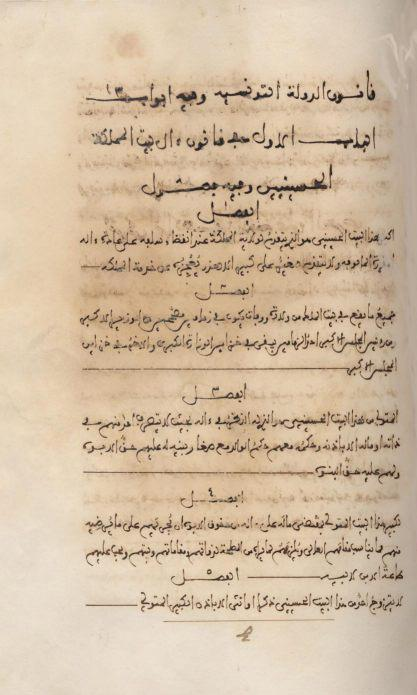
The image accompanying this essay reproduces the first page of the 1861 constitution in Arabic. Its source record attributes the manuscript to the Beylical administration of Tunis and the reproduction to the National Archives. The document’s historical date is 1861; the digitisation date is unspecified. The pictured page provides evidence of a material constitutional record. The article-number discussion above follows the separately referenced French text, used to identify the numbered provisions discussed in this essay. [7]
Preserving that distinction gives the image a precise place in the argument. A manuscript has a language, a physical form and a provenance; a later reproduction adds another stage to its circulation. Those stages matter when a constitutional document becomes available to new readers. The source record allows the historical object to be identified and its reproduction credited, while the political meaning of particular provisions must be established through the text and its documented interpretation. [7]
Tunisia’s experiment organised restraint through recognised offices and social authorities. Reading institutional rules alongside the distribution of participation shows how the constitutional text arranged power and the channels through which it could be questioned. [6]
- [1]Ministry of Justice, Tunisia. Constitution du 26 avril 1861—French text26 April 1861; modern transcription undated
- [2]Muhammad Bey; transcription of Auguste Sebaut’s 1888 edition, Wikisource. Pacte fondamental tunisien10 September 1857; edition 1888
- [3]Hédia Khadhar, Revue des mondes musulmans et de la Méditerranée / Persée. La Révolution française, le Pacte fondamental et la première Constitution tunisienne de 1861, pp.132–1371989; discussion used from pp.132–134
- [4]Andrew F. March, American Journal of Islam and Society. Islamic Constitutionalism Before Sovereignty: Two Defenses of the Tunisian Constitution of 186116 May 2020
- [5]Fabian Johannes Stroetges, Durham University. The Constitution and Re-Constitution of Citizenship: Political Change in Tunisia since 2011, chapter 32021 repository citation; manuscript 2020
- [6]Tania Abbiate / Institute for International and Comparative Law in Africa. Tunisia: Introductory notes—Origins and Historical Development of the ConstitutionUndated; consulted 12 October 2026
- [7]Beylical administration of Tunis / Wikimedia Commons. First page of the Tunisian Constitution of 18611861 document; digitisation date unspecified
Did this publication help you understand the topic?
0 voluntary responses. Browser-based participation; responses are not a representative survey.
We welcome suggestions, contributions and recommendations.
Editorial standards ↗