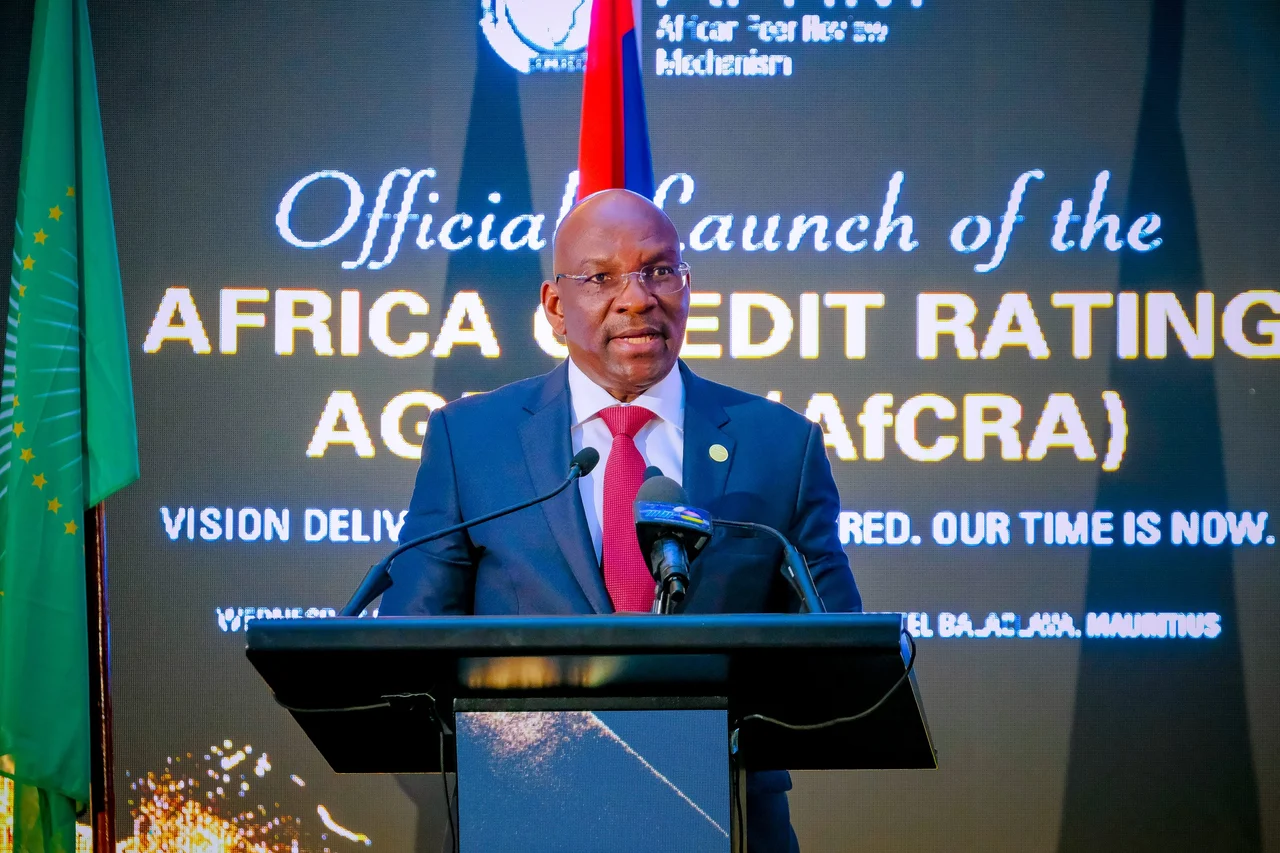
The Africa Credit Rating Agency, AfCRA, launched in Mauritius on 7 October 2026, according to the African Union’s readout and the Economic Commission for Africa’s subsequent account. ECA identifies Port Louis as the location and Mauritius as the agency’s headquarters jurisdiction. The initiative creates a further African-led institution producing credit information about governments and businesses. Its announced role connects the interpretation of economic evidence to access to finance. [1] [2]
The launch drew AU, APRM, Mauritian, UN and African financial-institution representatives. Their public statements emphasised independence, data and technical credibility. Afreximbank’s statement, issued on 8 October, set out its expectations for an African-controlled source of credit opinion. The accompanying photograph identifies executive Denys Denya addressing the event on 7 October. That chronology distinguishes the launch from the later statement reporting support for it. [1] [3]
The AU readout locates the agency’s development within work by the African Peer Review Mechanism and AU policy organs. It attributes to APRM chief executive Marie-Antoinette Rose-Quatre an account of technical, operational and governance preparation. The readout also identifies Mauritian minister Jyoti Jeetun’s position that the host jurisdiction can connect capital with African opportunities. These statements document the institutional project and its intended place within African financial architecture. [1]
ECA describes AfCRA as independent and driven by the private sector. Its 8 October account identifies Sifiso Falala as chief executive and outlines prospective assessment of sovereign borrowers, subnational entities and companies. Those categories connect the initiative to different levels of public and commercial authority. The reported institutional design concerns who supplies credit analysis, whose economic circumstances enter it and how investors can encounter additional information. [2]
Afreximbank’s statement identifies gaps in coverage, including unrated issuers and limited local-currency and sub-sovereign assessment. The bank argues that broader, credible coverage can support domestic and regional capital markets. That is a stated mechanism: additional assessment may give investors information about issuers previously absent from a rating system. The statement establishes the bank’s rationale and expectations; a change in lending, investment or an issuer’s costs requires evidence from those transactions. [3]
The bank also calls for assessment that takes African multilateral institutions’ legal frameworks, mandates and operating models into account. Its intervention makes the selection and interpretation of institutional characteristics part of the credit-information question. Afreximbank is both an issuer of this argument and a financial institution with an interest in how such assessments are made. The statement’s claims are therefore attributed to the bank, while the agency’s own published arrangements provide a separate record of its commitments. [3] [4]
AfCRA’s governance page says its arrangements seek to protect analysis from political influence, shareholders, issuer pressure and commercial considerations. It lists independent rating committees, separation of analytical and commercial work, conflict management and controlled methodology changes. These published commitments name the institutional boundaries within which a credit judgement is supposed to be made. [4]
The page includes appeals, factual correction, complaints, performance monitoring and confidentiality. These functions carry different responsibilities: challenges to factual information, formal analytical decisions and organisational oversight. Particular committee decisions, handled complaints and conflict-control records would demonstrate the operation of this published architecture. [4]
The agency’s methodology page describes a path from observable evidence through indicators and composite dimensions to an overall credit assessment. Its stated inputs include financial reports, legal filings, official statistics, market signals and issuer submissions. It also identifies management meetings and site visits among possible verification activities. These are descriptions of the proposed analytical system; the page does not document a specific visit or credit decision. [5]
AfCRA lists ratings and outlooks, key drivers, sensitivities, scenarios and an auditable rationale among its outputs. Its stated process also includes version control and testing against observed credit outcomes. These features make the movement from data to judgement an identifiable subject of scrutiny. A published assessment can then be read for the evidence used, the assumptions carrying its conclusion and the circumstances under which that conclusion changes. [5]
The team page names Sifiso Falala as chief executive and Ted Maselesele as chief ratings officer. It also identifies roles in legal advice, data science, compliance and business development, alongside non-executive directors. The page documents how the agency publicly presents its leadership and areas of responsibility. It supplies no independent assessment of performance, but provides named institutional roles through which the published analytical and governance arrangements can be followed. [6]
The distinction between ratings, compliance and commercial development is central to the stated governance arrangement. Rating decisions concern creditworthiness; business development concerns commercial relationships; compliance concerns controls. Reading the team and governance pages together identifies the organisational separation AfCRA presents. Decision and oversight records would establish how conflicts are handled when those responsibilities intersect. [4] [6]
ECA’s account reports launch speakers calling for reliable economic data, credible institutions and stronger economic fundamentals. It also records the UN Special Adviser on Africa’s call for African financial institutions to use the agency’s ratings. These interventions connect an institution’s establishment to the later decisions of issuers, regulators and investors. Market use and recognition are subsequent steps in that chain, with their own documentary evidence. [2]
The AU readout presents financial sovereignty as part of Africa’s capacity to shape the information through which its economies are assessed. Its stated standards include independence, transparency and scrutiny of the agency’s work. The concrete change recorded this month is an institution’s launch and the publication of its commitments. Effects on borrowing, public budgets and development finance must be traced through subsequent assessments and financial decisions, with their dates and affected issuers identified. [1] [5]
AfCRA’s launch gives African institutional agency a concrete setting: the production and governance of credit information. The named offices, published analytical stages and stated safeguards show where that authority is supposed to operate. The next evidential stage lies in issued assessments, regulatory recognition, observed performance and decisions by investors and borrowers. Those records will allow the public to examine how African control over an institution translates into credible knowledge and financial outcomes. [2] [4] [5] [6]
- [1]African Union Commission. AU Commission Chairperson Helps to Officially Launch Africa Credit Rating Agency (AfCRA)7 October 2026
- [2]United Nations Economic Commission for Africa. Africa launches credit rating agency to address financing challenges8 October 2026; dates the launch to 7 October
- [3]Afreximbank / APO Group. Afreximbank welcomes launch of Africa Credit Rating Agency as an important step in strengthening Africa’s financial architecture8 October 2026; accompanying photograph dated 7 October
- [4]Africa Credit Rating Agency. Governance & IndependenceUndated institutional page; consulted 12 October 2026
- [5]Africa Credit Rating Agency. MethodologiesUndated institutional page; consulted 12 October 2026
- [6]Africa Credit Rating Agency. AfCRA Team: executive leadership and institutional rolesUndated institutional page; consulted 12 October 2026
Did this publication help you understand the topic?
0 voluntary responses. Browser-based participation; responses are not a representative survey.
We welcome suggestions, contributions and recommendations.
Editorial standards ↗