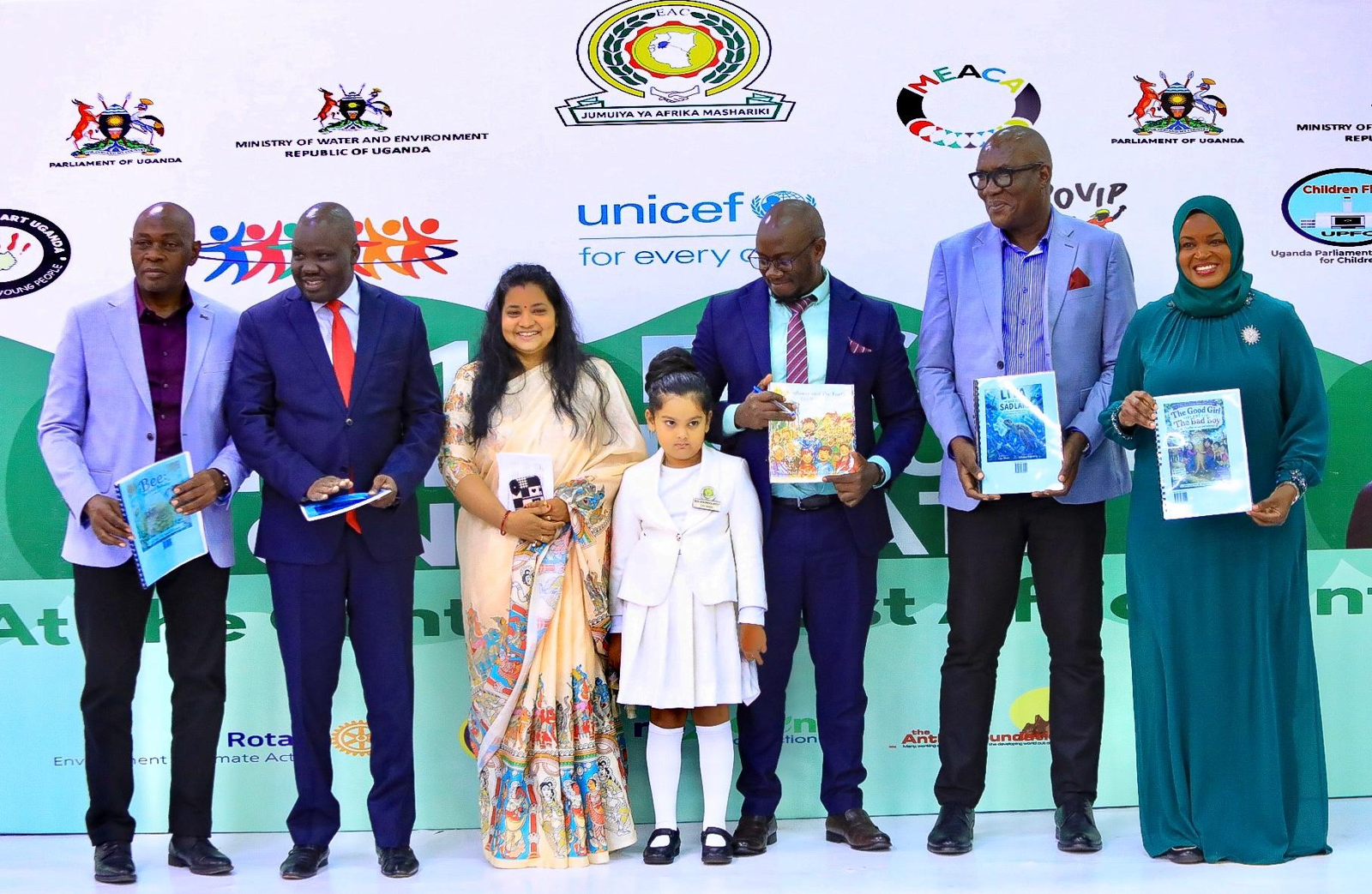
Legislators called for children to participate in regional climate decisions at a summit held at Uganda’s Parliament in Kampala on Friday, 16 October 2026. Parliament’s account identifies Uganda Parliamentary Forum for Children chair Susan Abeja, East African Legislative Assembly members and EAC Deputy Secretary General Andrea Ariik Malueth among those involved. The public event placed representation across generations within a discussion of East African integration. [1]
The parliamentary report attributes to Abeja a call for meaningful involvement in policy. UNICEF Uganda official Lalit Patra proposed constituency commitments and youth groups; Water and Environment Ministry representative Flavia Byekwaso called for resilient schools, clean water and renewable energy. These were proposals recorded at the summit. The report identifies no new appropriation or permanent participation procedure. It also scheduled tree planting for 17 October; that announcement establishes the plan, with completion requiring a subsequent record. [1]
The Committee on the Rights of the Child’s 2023 General Comment No. 26 provides a specific interpretation of what being heard involves. It calls for safe, accessible and age-appropriate participation throughout environmental decision-making, adequate information and time, and feedback explaining how children’s views were considered. It also addresses additional support for children with disabilities and others facing barriers. This is the committee’s interpretation of the convention, published three years before the Kampala meeting. [2]
These provisions identify an observable sequence: when views were invited, what information was supplied and how an institution responded. The committee also recognises children’s organisations and creative forms of expression. Attendance and a policy consultation record answer different questions about participation; the latter records how views were handled while making a decision. [2]
UNICEF’s June 2026 Children’s Climate Risk Report defines risk through hazard, exposure and vulnerability. Exposure concerns the presence of children or essential infrastructure where a hazard may occur; vulnerability concerns susceptibility to harm and capacity to cope. That distinction explains the policy significance of schools, water systems and health services. Protecting those systems changes the conditions under which a hazard affects daily life. The report provides a framework for examining public decisions about resilience. [3]
The report estimates that 1.1 billion children globally are exposed to at least three overlapping climate hazards. This is a global exposure estimate, not a count of Ugandan victims or children affected by an event in October. UNICEF connects risk reduction to resilient child-critical services and participation in decisions about climate policy and finance. The measurement’s scale and definitions matter when numbers enter a local political discussion: exposure, experienced damage and the effectiveness of a response require different evidence. [3]
The EAC’s environmental overview identifies freshwater, coastal systems, forests, wetlands, rangelands and mountain ecosystems among resources connecting livelihoods across borders. It locates its mandate in the treaty’s environmental chapter. Such resources make regional cooperation relevant to services and economic activity experienced locally. A decision concerning a shared resource may involve several jurisdictions, each with its own institutions and affected communities. The overview supplies that geographical and administrative setting for the summit’s regional focus. [6]
The EAC also identifies pressures from pollution, resource depletion and conversion of wetlands. These are the institution’s regional descriptions, covering varied places and activities. They do not establish responsibility for a particular local incident. Their significance here is the range of public functions involved: land management, infrastructure, livelihoods and environmental protection intersect across boundaries. Including children in decisions within that setting requires attention to which institution holds authority over the specific policy under discussion. [6]
Articles 111–114 of the EAC treaty, signed in 1999 and available in consolidated form, provide for cooperation on environmental management and shared natural resources. Article 111 includes prior notification and early consultation where activities may have significant transboundary effects. It gives a concrete institutional location for examining how information travels among governments. The obligation predates the Kampala summit and concerns the handling of activities across state boundaries. [4]
Article 112 addresses common environmental management policy, disaster preparedness and assessment of development activities. Article 114 addresses natural-resource cooperation, including forests and water. The provisions identify sectors in which authorities already have a basis for collective action. When children’s participation is proposed, those existing policy processes become relevant places to examine how consultation is organised, recorded and connected to a decision. The summit report itself announces no amendment to these treaty provisions. [4]
The EAC’s explanation of its climate framework distinguishes policy, master plan and strategy. The policy guides collective adaptation and mitigation measures, prioritising adaptation in view of regional vulnerability and food-security concerns. The master plan supplies a longer-term operational vision, while the strategy guides policy implementation. These instruments perform different functions. Their existence establishes an institutional framework; a funded project or a completed service requires its own budget, delivery and monitoring records. [5]
That distinction gives practical direction to scrutiny of participation. The point at which children contribute can be recorded separately for policy preparation, programme planning and implementation. Information about an eventual decision can then be returned through the same process, consistent with the committee’s emphasis on feedback. Reading the regional framework alongside that interpretation clarifies what a sustained participation mechanism would have to connect: views expressed, the responsible institution and a documented decision. [2][5]
Kampala’s meeting made children’s involvement an explicit part of a regional political discussion. Its substantive follow-through can be examined in consultation procedures, constituency commitments, funding decisions and service records. The available documents connect representation to authority over shared resources and the public systems children use, providing a concrete basis for following what happens after the gathering. [1][3][4][5][6]
- [1]Parliament of Uganda. MPs call for children’s inclusion in regional climate decisions2026-10-16
- [2]UN Committee on the Rights of the Child / OHCHR. General comment No. 26 (2023): children’s rights and the environment, with a special focus on climate change2023-08-22
- [3]UNICEF. The Children’s Climate Risk Report 20262026-06
- [4]East African Community, hosted by East African Court of Justice. Treaty for the Establishment of the East African Community — Articles 111–1141999-11-30 (treaty; consolidated text)
- [5]East African Community. EAC Climate Change Policy FrameworkUndated; consulted 2026-10-17
- [6]East African Community. Environment and Natural ResourcesUndated; consulted 2026-10-17
Did this publication help you understand the topic?
0 voluntary responses. Browser-based participation; responses are not a representative survey.
We welcome suggestions, contributions and recommendations.
Editorial standards ↗