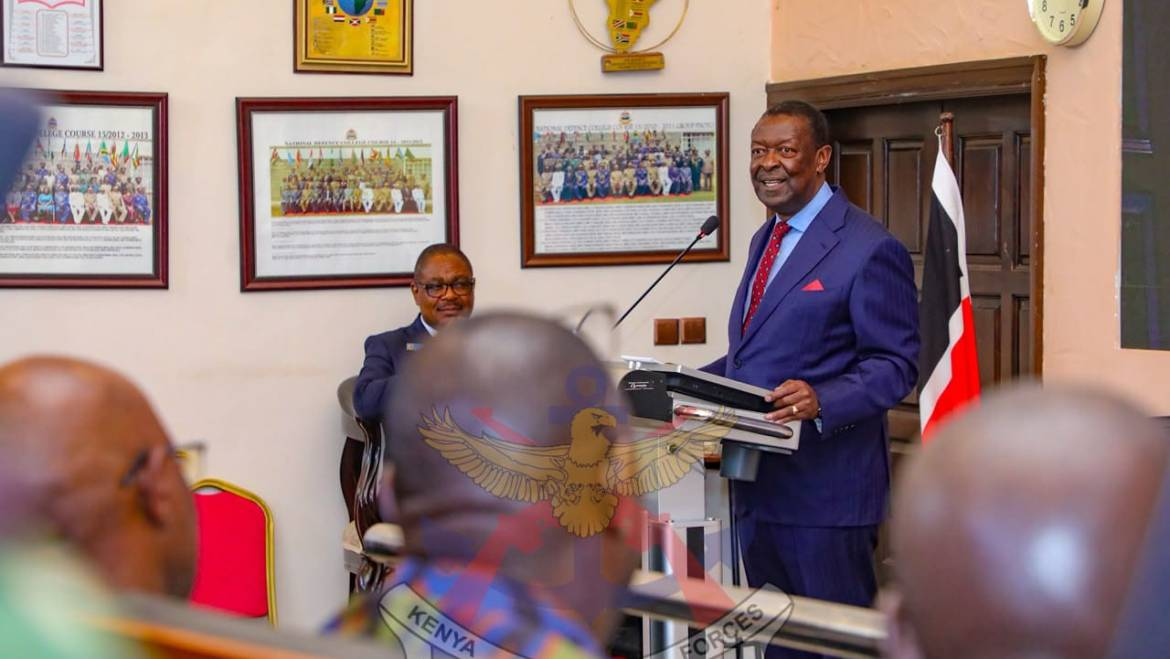
Kenya’s Prime Cabinet Secretary and foreign-affairs minister Musalia Mudavadi addressed National Defence College Course 29 on 14 October 2026, according to the Ministry of Defence’s report published the following day. He discussed geopolitical competition, Sudan and Al-Shabaab, and regional institutions. It announces no new deployment, appropriation or binding regional agreement. [1]
The ministry puts the class at 81 senior participants from the defence forces, other disciplined services, government bodies and allied countries in Africa and Asia. It presents the lecture as part of strategic leadership training and attributes to Mudavadi an emphasis on coordinating diplomacy with security objectives. The event’s institutional significance lies in senior civilian foreign-policy leadership addressing a mixed group preparing for security and public-administration responsibilities. [1]
The college’s earlier account dates the opening of Course 29 to 1 July 2026 in Karen, Nairobi. Defence Cabinet Secretary Soipan Tuya inaugurated the year-long programme. The institution identifies leadership, critical thinking and policy analysis as intended areas of study. That July record establishes the educational setting into which October’s lecture fitted. It records curriculum aims rather than a measurement of what graduates subsequently achieved in office. [3]
The opening account also identifies first-time participants from Eswatini, The Gambia and Morocco, alongside Kenyan officers, government officials and representatives of other partner countries. The composition gives the course a connection to administrative networks beyond Kenya. Its stated training remit encompasses national security policy and public administration. Reading the institutional description closely separates the programme’s intended contribution from evidence about later professional relationships or decisions. The reported international intake establishes participation in a shared educational setting. [3]
Kenya’s 2010 Constitution defines national security to include people, rights, freedoms and prosperity alongside sovereignty and territory. Article 238 subjects security to the constitution, Parliament and the rule of law. Article 239 places the security organs under civilian authority and requires non-partisanship. These provisions identify the legal setting for a discussion of strategic coordination: protecting national interests is a public function exercised through specified institutions and responsibilities. [2]
Article 240 assigns integration of domestic, foreign and military security policy to the National Security Council and requires an annual report to Parliament. Its external-deployment provisions require parliamentary approval. Article 241 separately addresses defence-force assistance during emergencies and approval for restoring peace amid unrest. These are existing constitutional rules, with distinct decision and reporting requirements. The lecture did not alter them. Establishing whether a particular operation followed those requirements would require its authorisation and reporting records. [2]
IGAD’s Council of Ministers met in Djibouti on 15 September 2026, with Kenya represented by foreign-affairs Principal Secretary Abraham Korir Sing’Oei. Its communiqué states that five of seven members had deposited ratifications of the 2023 IGAD Treaty, meeting the two-thirds threshold. It then directs depositary notification, certification and registration. The document distinguishes a threshold reached from formal steps still assigned to the secretariat. It is an earlier institutional development relevant to the regional organisation cited at the lecture. [4]
The same council requested stronger maritime coordination in the Red Sea and Gulf of Aden and reporting to its next ordinary session. It reaffirmed civilian protection, humanitarian access and a Sudanese-owned process regarding Sudan. Those are the council’s positions and administrative directions. They identify an assigned institution and a reporting destination, giving regional cooperation a traceable form. A later report would be needed to establish what the secretariat delivered under the maritime direction. [4]
The African Charter on Democracy, Elections and Governance, adopted in 2007, places constitutional civilian control over armed and security forces in Article 14. Article 15 concerns institutions supporting democratic order, their autonomy, accountability and resources. These are provisions addressed to states parties. Examining the adopted text identifies a continental formulation of the relationship between security institutions and constitutional government; establishing a particular state’s treaty obligations or compliance requires its own legal and implementation record. [6]
Articles 12 and 13 also address civic education, accountable administration, political dialogue and public trust. Article 16 envisages cooperation through exchange of experience. These provisions give the educational theme a wider institutional setting. They locate professional learning within a continental programme concerned with democratic governance and public institutions, while keeping the charter’s 2007 date distinct from the October 2026 lecture. [6]
The EAC treaty’s Articles 123–125 provide another existing framework for foreign, security and defence cooperation. Article 123 assigns its council an implementation role. That treaty dates to 1999; the lecture announced no amendment to it. [5]
Placed together, the July course description and October ministry report show where the government is presenting strategic priorities and which professional audiences it is addressing. The distinction between training and execution is consequential: course participation establishes an educational encounter, while a security operation requires its own legal and administrative record. Readers can follow the institutional sequence from formation of policy knowledge to the bodies empowered to decide and supervise action. [1][3]
The constitutional and regional texts identify distinct coordinating and reporting bodies, including Kenya’s National Security Council and Parliament and IGAD’s council and secretariat. Their records provide places to follow the relationship between sovereignty and accountability when later decisions are announced. Each document keeps its own date, institutional authority and function in that sequence. [2][4][6]
The documented development is a foreign-policy intervention in strategic education. Its relevance lies in the relationship between civilian leadership, security professionals and regional organisation. The records identify the setting and existing decision frameworks; future operational claims can be assessed against the particular authorisations and reports those frameworks require. [1][2][3][4][6]
- [1]Ministry of Defence, Kenya. Kenya’s Foreign Policy and Strategic Diplomacy in an Evolving Global Security Landscape2026-10-15
- [2]Republic of Kenya, hosted by Ministry of Defence. The Constitution of Kenya, 2010 — Articles 238–2412010-08-27
- [3]National Defence College, Kenya. Opening of National Defence College Course 29, 2026–20272026-07-01
- [4]Intergovernmental Authority on Development. Communiqué of the 74th Extraordinary Session of the IGAD Council of Ministers2026-09-15
- [5]East African Community, hosted by East African Court of Justice. Treaty for the Establishment of the East African Community — Articles123–1251999-11-30 (treaty; consolidated text)
- [6]African Union. African Charter on Democracy, Elections and Governance — Articles 12–16Adopted 2007-01-30
Did this publication help you understand the topic?
0 voluntary responses. Browser-based participation; responses are not a representative survey.
We welcome suggestions, contributions and recommendations.
Editorial standards ↗