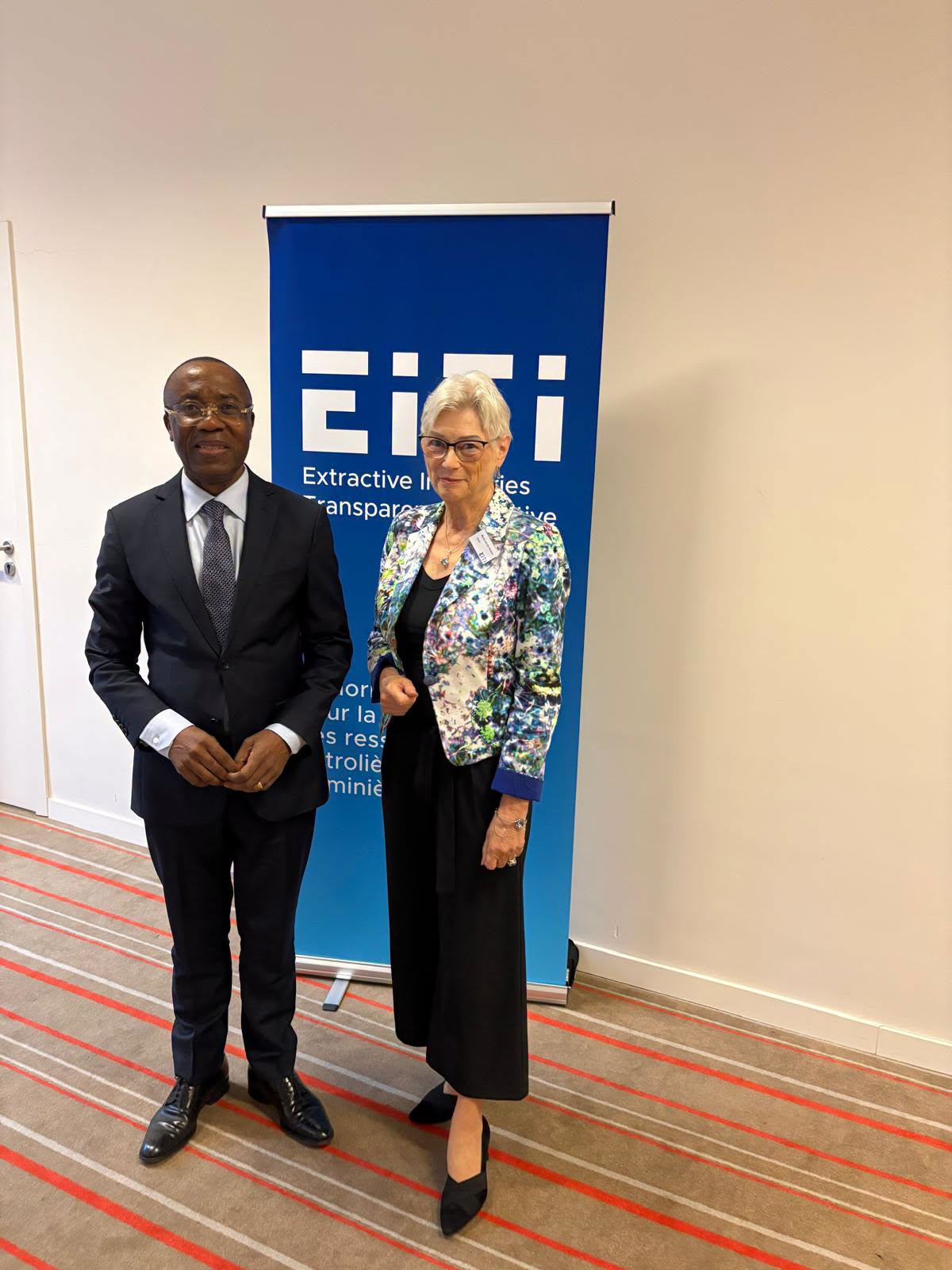
Fuh Calistus Gentry, Cameroon’s acting minister responsible for mines, industry and technological development, met EITI Board Chair Maria van der Hoeven in Brussels on 9 October 2026. MINMIDT’s original dated post identifies the meeting and shows the photograph accompanying this report. The occasion brought the country’s request before the chair of the international body that assesses implementation of the Extractive Industries Transparency Initiative’s requirements. [7]
In its 12 October release, the ministry said the discussions addressed corrective measures under Requirement 1.3, concerning the free and effective participation of civil society. It outlined plans to appoint a deputy national coordinator and technical staff for Cameroon’s EITI secretariat. It also described an intended timetable, developed with the National Hydrocarbons Corporation, for publishing petroleum contracts, financial statements and sectoral data. These items were presented as commitments and planned steps. [1]
The EITI country page, checked on 12 October, continued to describe Cameroon as suspended for inadequate stakeholder engagement and identified 2024 as its latest validation. That published status records the country’s standing in the initiative at publication time. [3]
The EITI Board’s 29 February 2024 decision gave Cameroon an overall score of 53 points under the 2019 Standard. It suspended the country because the civil-society-engagement requirement had been assessed as partly met. The same decision recorded a 71.5-point transparency component and acknowledged strengthened disclosures in some areas. The suspension arose within a validation process that assessed several dimensions of implementation, including participation, publication of information and its use in public debate. [2]
The decision set 1 April 2027 as the date for the next validation to begin and identified corrective actions. It also provided for Cameroon to request an earlier validation. This establishes a documented route through which evidence of changes can enter a new assessment. An early request, the beginning of a review and the board’s eventual decision each have their own place in that procedure, with the outcome determined through the initiative’s assessment process. [2]
The EITI civil-society protocol defines participation through expression, operation, association, engagement and access to public decision-making. Its scope includes organisations substantively involved in the EITI process, extending beyond those holding seats in the national multi-stakeholder group. It connects the publication of revenue information to the ability of people and organisations to discuss it, use it and take part in decisions about natural-resource governance. [4]
The protocol’s assessment considers practice, including whether representatives can speak about the process without coercion or reprisal and whether they can communicate with other organisations. It also covers the use of reports and public comment on extractive governance. These are defined assessment questions within the initiative. Applying them involves evidence of how participation operates, with attention to the circumstances of the country and the information available to validators. [4] Documentation can include meeting minutes, civil-society submissions and the outcomes of stakeholder consultations; the protocol identifies these as material for evaluating participation. [4]
Cameroon’s 2023 EITI report, published in December 2025, provides a separate record of extractive-sector payments. It reports total payments to the state of 1,232.69 billion Central African CFA francs for the 2023 fiscal year, including reconciled payments and unilateral declarations outside the reconciliation scope. Its summary attributes 95.12% of that payment total to hydrocarbons. These figures describe the report’s defined fiscal period and payment methodology; they are not current-year revenue estimates. [5]
The report separately records 1,035.85 billion Central African CFA francs in extractive revenues captured by the state budget for 2023. It also distinguishes cash payments, payments in kind and direct or indirect transfers involving the national hydrocarbons corporation. The categories identify different stages and destinations in the financial record. Following a payment into a budget requires matching the reporting entity, type of payment, transfer arrangement and fiscal period. These categories give each financial amount its defined role in the report. [5]
The EITI Global Conference took place in Brussels on 8–9 October 2026, co-hosted by Belgium and the European Commission. Its published account describes participation by governments, companies, civil-society organisations and development partners. The event’s stated theme addressed transparency and shared prosperity. It provided a setting in which countries implementing the initiative could discuss natural-resource governance with the constituencies that participate in its international institutions. [6]
The conference account emphasises the use of disclosure in policymaking and public dialogue. That gives context to the Cameroon request: the initiative’s work links information about extraction to decisions concerning the distribution of its benefits. The current meeting belongs to that international engagement, while the country’s institutional status is recorded separately through validation and board decisions. The conference itself supplied a forum for exchanges among the participating actors. [6]
The country page links EITI to disclosures of mining licences and national oil-company payments, and identifies revenue-sharing with host communities as an area for public debate. This places public access to data and social participation within its stated relevance for resource governance. [3]
The ministry said it intends to seek early validation after establishing a clear reform timetable. Its release identifies appointments, publication schedules and civil-society participation as the matters to advance. The proposed sequence places a reform timetable before a request for early assessment. [1]
The Brussels engagement places a current government request alongside a continuing published suspension. Readers can follow the next change in status through the EITI’s country record and the decision-making process that governs it. The distinction keeps the reported diplomatic engagement, proposed measures and institutional outcome anchored to their documented stages. [3]
- [1]MINMIDT, Cameroon / APO Group. Cameroon Advocates for Lifting of EITI Suspension in Brussels12 October 2026; meeting 9 October 2026
- [2]EITI Board. Cameroon has achieved a fairly low overall score in implementing the 2019 EITI Standard—Decision 2024-1729 February 2024
- [3]EITI International Secretariat. Cameroon—country status and implementation overviewUndated live page; checked 12 October 2026
- [4]EITI. Protocol: Participation of civil societyJanuary 2015; version consulted 12 October 2026
- [5]Cameroon EITI National Secretariat. Rapport ITIE 2023, summary tables 1–4 and methodological notesDecember 2025; fiscal year 2023
- [6]EITI. 2026 EITI Global ConferenceEvent 8–9 October 2026; page checked 12 October 2026
- [7]MINMIDT, Cameroon. Original dated announcement of the Brussels meeting with the EITI Board chair9 October 2026 event; original publisher post
Did this publication help you understand the topic?
0 voluntary responses. Browser-based participation; responses are not a representative survey.
We welcome suggestions, contributions and recommendations.
Editorial standards ↗