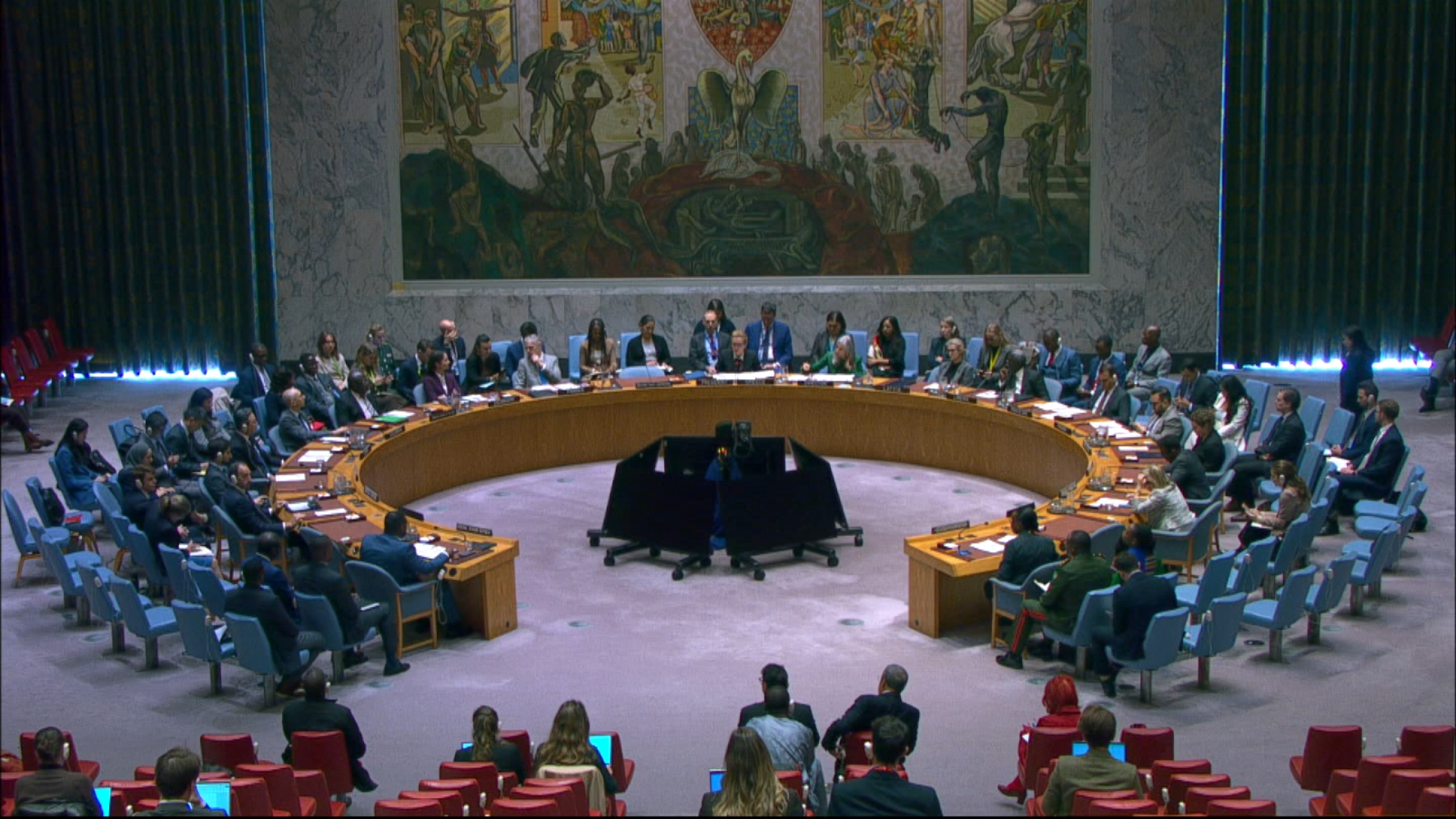
The Security Council discussed the Central African Republic on 20 October 2026 as MINUSCA approaches its 15 November mandate deadline. In New York, UK representative Jess Jambert-Gray called for a gradual, conditions-based security transition. The pending decision concerns the organisation of protection responsibilities alongside the development of national and elected local institutions. [1][3]
The UK statement supported a transition coordinated with the Central African government and stressed accountable, inclusive security institutions. It also highlighted the need for former combatants to obtain reintegration opportunities. These are the British government’s positions in the renewal debate. They establish the conditions that one Council member is advocating; the speech records neither a new Council resolution nor a completed transfer of responsibilities. Its emphasis on sequencing connects the diplomatic timetable to the ability of national institutions to perform the tasks they would assume. [1]
MINUSCA head Valentine Rugwabiza described a separate institutional process already under way inside the country. According to the UNifeed record of her briefing, elected officials had been installed in 127 of 177 municipalities by 1 October. She said the new authorities urgently needed capacity-building support, including from development partners and the Peacebuilding Fund. The figure describes installation of officials at a specified date. It supplies no municipal expenditure total or measure of services delivered. For residents, the next stage involves the administrative means through which those elected bodies can exercise their responsibilities. [2]
The Central African Republic’s own representative, Marius Aristide Hoja Nzessioué, told the same meeting that the government was pursuing the restoration of state authority, stronger republican institutions and implementation of the peace process. His intervention also described the economic consequences of successive crises as a burden on citizens and state capacity. Read together, the two interventions place national political leadership and local administration within the transition discussion. Both are statements by institutions involved in the process, and their assessments of progress remain attributable to those speakers. [2]
Resolution 2800, adopted on 13 November 2025, gives the Central African government primary responsibility for protecting the population. MINUSCA’s tasks include civilian protection and support for the peace process. Support for national security-force deployment is subject to conditions, including human-rights due diligence. The resolution also requires evidence-based assessment of mission impact. These provisions supply criteria for examining whose safety is considered as protection responsibilities change. They remain part of the existing authorisation being considered for renewal. [3]
Local authority has a documentary foundation in the Political Agreement for Peace and Reconciliation, signed in Bangui on 6 February 2019 after negotiations in Khartoum. Article 4 committed the government to decentralisation through transfers of responsibilities and resources. It linked the allocation of tasks to community needs. This gives October’s municipal-installation figures an institutional history: the settlement envisaged material governing capacity alongside local structures. The agreement remains a record of commitments, requiring subsequent implementation evidence. [4]
Other provisions addressed natural-resource revenues, transfers to territorial units and equitable regional development. They envisaged professional security institutions, inclusive recruitment and support for displaced people’s return. These commitments connect the peace settlement to representation, protection and access to services. Establishing their implementation requires laws, transfers and administrative records. The 2019 text cannot establish what a municipality received in 2026, or how residents experienced the exercise of its authority. [4]
The World Bank’s current country overview identifies severe constraints on those resources. It projects domestic revenue at 7.0 per cent of GDP in 2026 and describes expensive short-term borrowing and rising interest costs as pressures on public finances. These are the Bank’s estimates and assessment, accessed on 21 October. They help explain why the resource side of decentralisation matters to the present transition: national and local responsibilities depend on the public funds available to sustain them. The projection is not an audited revenue outturn. [5]
The same overview describes mining as an important export driver that creates relatively few jobs, and reports substantial gaps in electricity and sanitation access. This distribution matters when interpreting economic recovery: export receipts, household employment and municipal service provision are different measures. The Bank also identifies UN peacekeeping reorganisation among the influences on the economic outlook. That assessment places the security transition within the country’s fiscal and productive relationships, while leaving the actual scale and distribution of any future effects to be established through subsequent evidence. [5]
The Bank’s Summer 2026 CEMAC Economic Barometer provides regional context for this financing problem. It estimates that regional growth slowed to 2.6 per cent in 2025 and that per-capita income declined slightly. It also describes weaker commodity revenues, spending pressures and constraints on private credit. Those regional aggregates cover economies with different production structures and do not measure an individual Central African municipality’s circumstances. Their relevance lies in the wider financial environment in which national borrowing, employment and public investment are organised. [6]
The barometer attributes stronger Central African growth in 2025 partly to gold exports and calls across the region for better revenue mobilisation, spending efficiency, infrastructure and investment in people. These are the institution’s interpretation and policy recommendations. They identify channels through which economic resources might support public authority; they do not demonstrate that a particular local budget has been financed. Connecting the regional outlook to municipal responsibilities requires country-specific decisions about how revenue is collected, allocated and transferred. [6]
The forthcoming mandate decision will specify MINUSCA’s next authorisation. Central African institutions are meanwhile assuming local functions within a peace framework that links decentralisation to resources. These documents identify protection duties and institutional commitments whose implementation can be followed through subsequent decisions and public records. [3][4]
- [1]Foreign, Commonwealth & Development Office, United Kingdom. The United Kindgom welcomes the continued consolidation of peace and stability in the Central African Republic: UK statement at the UN Security Council2026-10-20; delivered at the Security Council, New York
- [2]United Nations / UNifeed. UN / CAR — Security Council briefing and statements, unifeed261020e2026-10-20; municipal installation figures as of 2026-10-01
- [3]United Nations Security Council. Resolution 2800 (2025), reproduced in the UN Mandate Registry2025-11-13
- [4]Government of the Central African Republic and signatory armed groups; UN document S/2019/145. Political Agreement for Peace and Reconciliation in the Central African Republic, annex to S/2019/145Signed 2019-02-06; transmitted in UN document dated 2019-02-15
- [5]World Bank. Central African Republic — country overview, political context and economyUndated live overview; accessed 2026-10-21; 2026 projections
- [6]World Bank. Economic Barometer for the Central African Economic and Monetary Community – Summer 2026Summer 2026; summary accessed 2026-10-21; 2025 estimates
Did this publication help you understand the topic?
0 voluntary responses. Browser-based participation; responses are not a representative survey.
We welcome suggestions, contributions and recommendations.
Editorial standards ↗