The EU Council adopted a €20 million assistance measure for Nigeria’s armed forces on 19 October 2026. Its Luxembourg session agenda places the decision at item 11, following preparation through the Permanent Representatives Committee. The measure creates a bilateral support channel whose approval, implementation and monitoring involve distinct institutional responsibilities. [1][5]
The Council identifies non-lethal assistance covering counter-improvised-explosive-device and counter-drone capabilities, night vision and individual protection. It presents the measure as support for troops deployed within Nigeria. The announcement records adoption; it provides no inventory of equipment handed over or civilian outcomes. [1]
Nigeria already received European Peace Facility support through the Multinational Joint Task Force in the Lake Chad basin. The first bilateral measure establishes a separate support channel for its armed forces, alongside regional cooperation described in the earlier joint communiqué. [1][3]
The European External Action Service dates the first EU–Nigeria Peace, Security and Defence Dialogue to 18 February 2026 in Brussels. Nigeria’s National Security Adviser Nuhu Ribadu and EEAS Deputy Secretary-General Charles Fries co-chaired it. The published account names counter-terrorism, maritime security, cyber and hybrid threats, disarmament and reintegration, and mediation among the areas discussed. These categories identify an agenda extending across domestic security, regional relationships and cross-border threats. [2]
A further part of that dialogue addressed transnational organised crime, with proposals involving Europol and dedicated consultations on foreign information manipulation and interference. The EEAS also framed the relationship through respect for Nigerian sovereignty. These are the institution’s descriptions of the agenda and its principles. They show how security assistance was being situated within a wider diplomatic relationship, with multiple administrative bodies involved in setting priorities. [2] The account also identifies dedicated work on maritime security and cybersecurity, connecting national institutions with issues that extend across territorial borders. [2]
The eighth Nigeria–EU ministerial dialogue met in Abuja on 23 March 2026. Its joint communiqué linked defence cooperation to implementation of the February dialogue’s common orientations. At that stage, the text described support under the European Peace Facility as a possibility being considered. Reading that March formulation alongside the October adoption establishes movement from a stated option towards an approved assistance measure, while preserving the date and institutional function of each record. [3]
The communiqué also placed security within a larger set of commitments involving human rights, democracy, rule of law, fundamental freedoms and cooperation among regional and international institutions. Its references to ECOWAS and the Multinational Joint Task Force identify regional connections in the bilateral relationship. These commitments matter when assessing the purposes for which support is justified and the standards against which implementation can be examined. They remain commitments whose fulfilment requires evidence from subsequent practice. [3]
The Council’s explanation of the European Peace Facility describes financing outside the EU budget, with member-state contributions determined through a gross-national-income distribution key. A Facility Committee made up of member-state representatives operates under the Council presidency’s chairmanship and adopts the annual budget and expenditure rules. This identifies who organises the funding mechanism. The amount announced for Nigeria belongs within a system of member-state decisions about military and defence assistance. [4]
The same account provides for risk assessment, mitigating measures and monitoring of commitments under international human rights and humanitarian law. It states that civil society can report violations and that the Council can suspend or terminate assistance in cases of infringement or abuse. Those provisions create an institutional connection between the use of support and decisions about its continuation. Monitoring records and responses to reports would show how that connection functions in a particular case. [4]
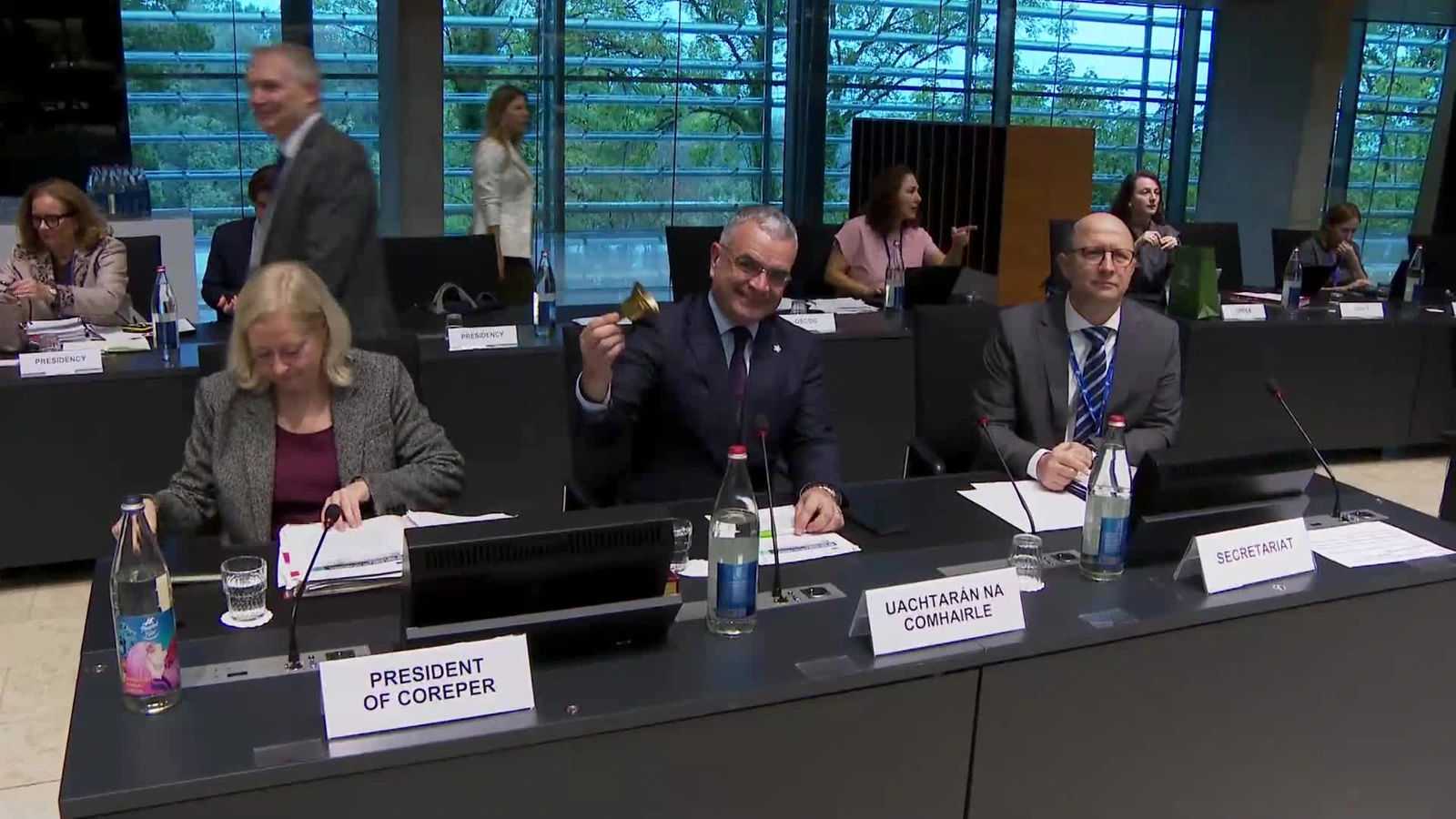
The non-legislative A-items list for 19 October records the Nigerian assistance measure as prepared through Coreper on 14 October, with adoption assigned to the Council. It identifies the file numbers and formal sequence. The Council’s subsequent release confirms the adopted measure. Together, the documents locate the decision within the EU’s internal process. The accompanying photograph shows that day’s Council session in Luxembourg; it depicts the authorising institution’s meeting and carries no claim to show Nigerian operations or delivery. [5][1] The agenda places this foreign-policy file alongside decisions in other policy fields. Its public identification allows readers to locate a security decision within the work of the Council as an institution, even though the meeting’s main configuration concerned employment and social policy. [5]
Voice of Nigeria reported on 18 October that Defence Minister Christopher Musa had received EU Ambassador Gautier Mignot and his delegation at Ship House in Abuja. It attributed its account to a Ministry of Defence release dated 17 October and named the ministry’s media official. According to that report, a technical delegation was expected in Abuja in November to work on delivery arrangements. This is a reported Nigerian account of a planned implementation step. [6]
The broadcaster also reported discussion of the Multinational Joint Task Force and reintegration, including the minister’s call to prioritise people affected by conflict. Those stated priorities put people’s security and the treatment of conflict-affected populations into the record of the meeting. Assessing the assistance will involve following how such priorities enter the practical arrangements, including who receives support, what conditions govern its use and which institutions record the results. [6]
The October adoption changes the formal basis of EU bilateral defence support to Nigeria. Earlier dialogue records identify how priorities were negotiated; the facility’s published rules identify financial authority and monitoring powers. The next stages can be followed through delivery arrangements, expenditure records and evidence about use. This sequence makes security cooperation open to public scrutiny through named decisions and responsibilities, with the rights and security of affected people central to assessing its consequences. [1][2][3][4][5][6]
- [1]Council of the European Union. European Peace Facility: Council adopts assistance measure to support defence capacities of Nigeria2026-10-19
- [2]European External Action Service. The European Union and Nigeria launch first Peace, Security and Defence Dialogue and agree to enhance collaboration2026-02-19; dialogue 2026-02-18
- [3]Federal Republic of Nigeria and European Union. Joint communiqué: eighth Nigeria–EU ministerial dialogue2026-03-23
- [4]Council of the European Union. European Peace Facility: governance, monitoring and complianceUndated updated policy page; consulted 2026-10-20
- [5]Council of the European Union. 14363/26: List of A items, non-legislative activities, Council of 19 October 2026, item 112026-10-16; Council session 2026-10-19
- [6]Voice of Nigeria; Nokai Origin, Abuja. EU Plans €20m Defence Aid Package for Nigeria2026-10-18; cites ministry release 2026-10-17
Did this publication help you understand the topic?
0 voluntary responses. Browser-based participation; responses are not a representative survey.
We welcome suggestions, contributions and recommendations.
Editorial standards ↗