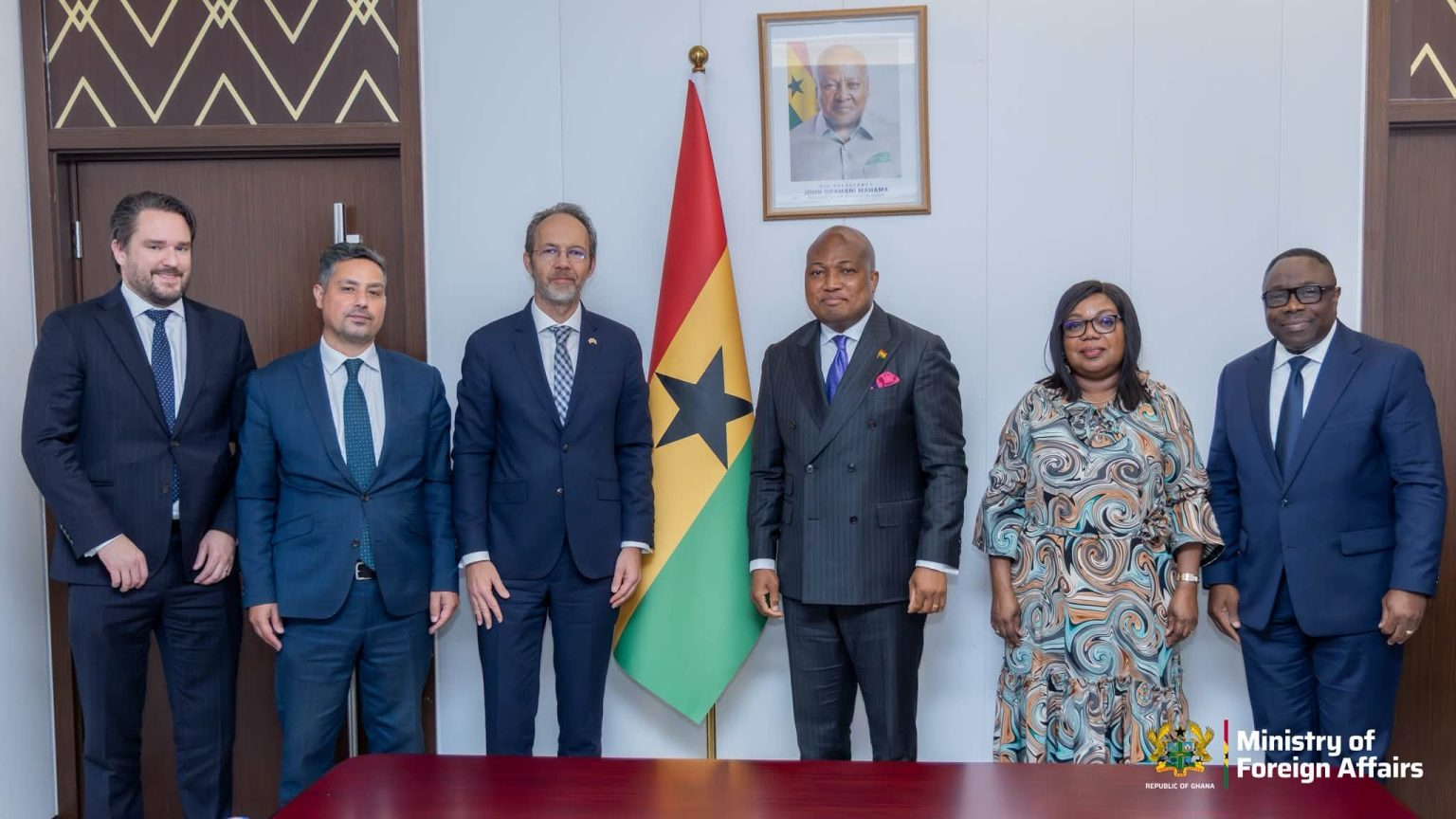
Samuel Okudzeto Ablakwa met British High Commissioner Christian Rogg on 9 October, according to Ghana’s Foreign Ministry release published on 12 October. The statement records the minister’s appreciation of UK participation in two Ghana-convened events on the margins of the 81st UN General Assembly in New York. This is a documented bilateral engagement with an agenda Ghana has also pursued through continental, Caribbean and UN institutions. [1]
The presidency’s 19 September itinerary announced an Accra Reset meeting for 21 September and a reparatory-justice event for 23 September. The latter was organised around international cooperation for the return and restitution of cultural property and heritage. These dates identify the events referred to in the October bilateral statement. The September announcement also placed diaspora engagement and meetings with international leaders within the president’s planned New York programme. [7]
That itinerary separated several activities: development-policy discussions, the reparatory-justice event, Ghana’s General Debate address and a diaspora town hall. Its structure shows the different audiences through which the government intended to pursue the agenda. Those announced engagements formed part of a broader diplomatic programme. The current October release reports appreciation of participation in the events; the earlier itinerary supplies their dates, subjects and planned place within Ghana’s international engagement. [7]
In a 16 September statement, Ghana’s Foreign Ministry said the June Accra Next Steps conference had been followed by the establishment of three bodies: a high-level advisory council on reparatory justice, a global experts panel on cultural-heritage restitution and a global legal panel on reparatory justice. The statement described the September side event as an occasion to receive progress reports from the panels. Their creation was presented as a mechanism for developing the government’s programme. [2]
The three bodies have different stated fields: broad advice, cultural heritage and legal work. That differentiation matters for following the process through public records. The 16 September statement identifies the organisational structure and its intended reporting occasion. It does not supply the panels’ completed case files or a bilateral settlement. Their reports and subsequent decisions would provide further evidence of how the announced organisation translates into specific proposals and action. [2]
The African Union’s 17 June account records a first joint meeting of its experts and legal-experts mechanisms with the CARICOM Reparations Commission. It describes collaboration on research, legal strategy, diplomacy, education, cultural programming and civil-society inclusion. The meeting was organised ahead of the 18–19 June conference in Accra. This connects Ghana’s activity to a documented transcontinental process involving African and Caribbean institutions, each with its own membership and mandate. [3]
According to the AU account, the meeting agreed a coordination structure with quarterly bureau meetings and at least an annual plenary. The AU’s Citizens and Diaspora Directorate and the CARICOM Secretariat were assigned communication channels, a collaborative-activities matrix and focal points. These are identifiable organisational arrangements through which joint work was intended to proceed. The account records the agreement to establish them, preserving a basis for following their subsequent operation. [3]
General Assembly Resolution 80/250 was adopted on 25 March 2026. Its operative text condemns the trafficking and racialised chattel enslavement of Africans and calls for dialogue on reparatory justice. It identifies possible measures including apologies, restitution, compensation, rehabilitation, guarantees against repetition and changes addressing systemic discrimination. The declaration places several forms of redress within the same international political programme, addressing Africans and people of African descent. [4]
The text also calls for the return of cultural objects, manuscripts and national archives of value to countries of origin, and for cooperation on education, remembrance and research. It requests a secretary-general’s report at the Assembly’s 82nd session. These provisions give the declaration a follow-up process within the UN system. These are calls and reporting arrangements in the resolution, with implementation to be followed through the participating institutions’ subsequent actions. [4]
UNESCO’s intergovernmental committee on return and restitution was established in 1978 to facilitate negotiations over cultural property. Its current explanation covers cases outside the application of the 1970 Convention, including property lost under foreign or colonial occupation. The committee can assist bilateral negotiations and propose mediation or conciliation. This is a separate, specified mechanism for examining particular return requests, with the object, countries and circumstances identified in the case. [6]
UNESCO describes the committee as advisory and states that it has no legal power to decide the cases brought before it. Its mediation procedures aim to support agreement between the parties. Establishing a return therefore involves the relevant request, negotiations and terms of settlement or another applicable legal process. The committee’s procedures concern specific property, countries and requests, and offer a framework for negotiations between the parties concerned. [6]
In the presidency’s published 22 September speech, Mahama linked the Accra Reset to political control, productive capacity and financial resilience. He announced the launch of A Sovereign Future for Health and described plans to convene governments, health bodies, finance institutions and other partners around country-level compacts. His account presented local industrial capacity and state purchasing as elements of the proposed development approach. These were the president’s policy aims and planned next steps. [5]
The speech also identified a presidential council, a guardians’ circle and a high-level panel on global health governance. Together with the reparatory-justice bodies, these arrangements show how Ghana’s government has organised distinct agendas concerning historical redress and the terms of international development cooperation. The October talks referred to UK participation in both sets of events. The document records that engagement while the delivery of specific programmes remains a matter for their own subsequent records. [5]
The new statement brings Ghana’s multilateral initiatives into a current bilateral discussion. It documents appreciation of participation, alongside preparations for a presidential UK visit and further cooperation. The concrete outcome established by this record is the 9 October engagement and the subjects reported by the ministry. Any restitution agreement, financing commitment or completed transfer will require its own dated record. [1]
- [1]Ministry of Foreign Affairs, Ghana / APO Group. Meeting with United Kingdom High Commissioner: A Comprehensive Review of Ghana–UK Bilateral Relations12 October 2026; meeting 9 October 2026
- [2]Ministry of Foreign Affairs, Ghana. Ghana will host a high-level side event on reparatory justice during the 81st UNGA session16 September 2026
- [3]African Union Commission. African Union and CARICOM Reparations Mechanisms Hold First Joint Meeting Operationalizing a Joint Mechanism on Reparative Justice17 June 2026
- [4]United Nations General Assembly (original French document, Commons copy). Declaration of the Trafficking of Enslaved Africans and Racialized Chattel Enslavement of Africans as the Gravest Crime against Humanity (A/RES/80/250)Adopted 25 March 2026; issued 26 March 2026
- [5]Presidency of Ghana. President Mahama’s remarks at the Accra Reset side event in New YorkPublished 22 September 2026
- [6]UNESCO. Return & Restitution Intergovernmental Committee—mandate and proceduresUpdated 8 September 2026
- [7]Presidency of Ghana. President Mahama leaves for New York for 81st UN General Assembly; expected to host two high-level side events19 September 2026
Did this publication help you understand the topic?
0 voluntary responses. Browser-based participation; responses are not a representative survey.
We welcome suggestions, contributions and recommendations.
Editorial standards ↗