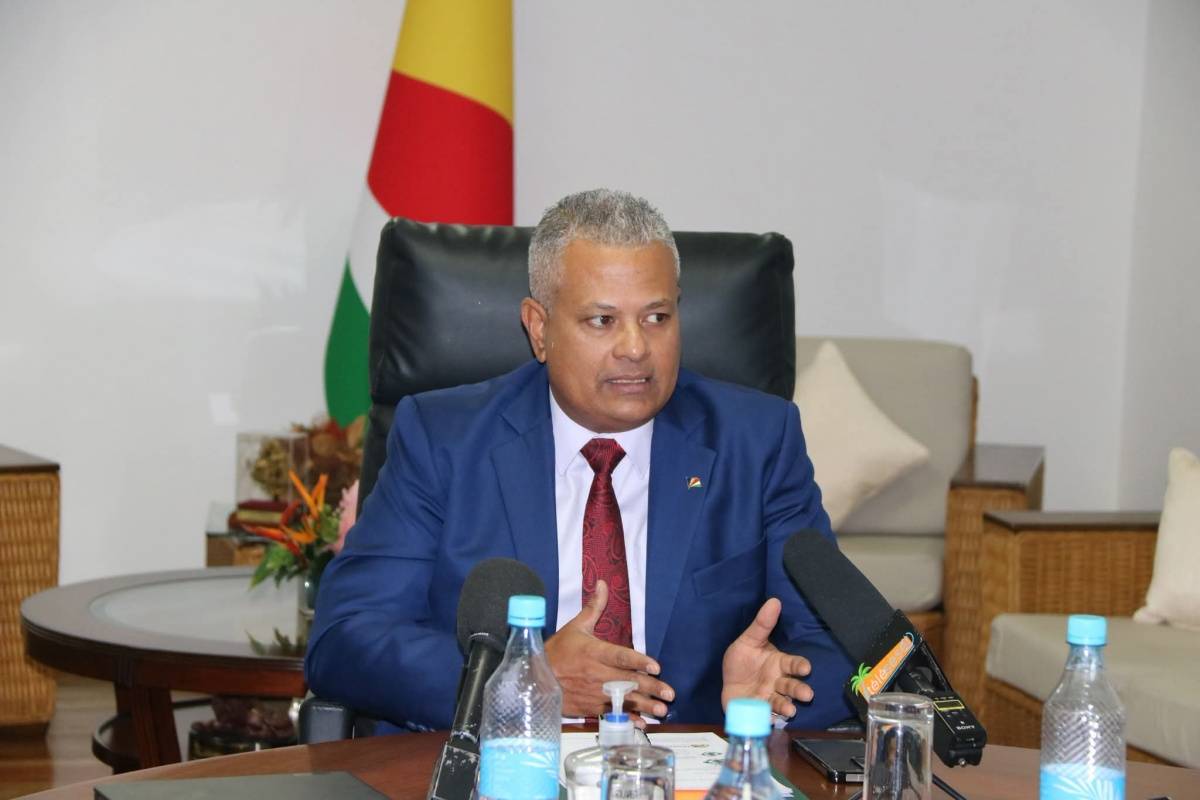
Vice-President Sebastien Pillay met FreeBalance representatives at State House on 14 October 2026. The government’s account identifies public-administration and ICT project managers among the participants, alongside Head of the Civil Service Margaret Moumou. It records expectations for a transition beginning next year, with public officers involved in the process. [1]
Pillay emphasised reducing administrative delays, changing manual procedures and retraining public officers to work with new technologies. The statement presents these as government intentions. It supplies no completed rollout or measured reduction in processing times. The proposed HRMS is part of an administrative change process whose practical results will depend on implementation and subsequent evidence. [1]
The Finance Ministry’s 2026 budget documentation says HRMS implementation began in 2024 and scheduled testing for the second quarter of 2026. It describes expected employee self-service functions, improved information management and changes to routine HR operations. These passages identify the project’s stated objectives and earlier timetable. A scheduled test records a planned activity; its completion would be established through the relevant testing and acceptance records. The October statement adds a later public target for beginning the transition. [2]
The same budget documentation records a SR17.1 million increase in the Department of Public Administration’s Goods and Services budget, primarily to finance HRMS. It describes phased development and provision for final software acquisition following installation, customisation and user acceptance testing. That amount is an increase in a departmental budget category, with HRMS identified as its main purpose. It is not presented as a standalone contract price, a payment already made or a statement that all project stages were completed. [2]
Cabinet’s 9 September decisions, published on 10 September, authorised development of a modern legal framework for the governance and management of the public service. The Department of Public Administration was to consult stakeholders with the Attorney-General’s Office before submitting a draft bill to Cabinet. The decision therefore specified both the responsible offices and a consultation stage. Approval to develop that framework represents a step in preparing legislation, with later approval and enactment requiring their own records. [3]
The same Cabinet account endorsed a Digital Economic Transformation Forum intended to bring government, business, academia and other participants together around architecture, priorities and an implementation roadmap. That is a stated coordination mechanism. Within the public-service programme, the consultation and planning stages create identifiable occasions for recording whose views were sought and how proposals developed. The September decisions describe these intended processes; the account does not establish that the proposed public-service bill had already become law. [3]
The government’s 23 June statement records the launch of the revamped egov.sc portal on the previous day. It identifies a joint initiative of the Department of Information and DICT. Under the announced arrangement, the Department of Information would manage content and DICT would retain responsibility for technical functions. These assignments distinguish responsibility for information presented to residents from responsibility for the systems through which that information is delivered. They concern the portal and should be followed within that project’s own records. [4]
The June account described improved access to government information as an objective of the relaunch and identified maintenance as an ongoing responsibility. Its allocation of content and technical functions provides an institutional basis for following that work. Residents and organisations were invited to use the updated portal. The published account establishes the launch and the responsibilities assigned to departments; its stated aspiration for better public access can be followed through the information and services subsequently made available there. [4]
The Information Commission’s current explanation of the Data Protection Act, 2023 identifies principles for lawful collection, specified purposes, accurate information, security and retention. It says the framework applies to public bodies and organisations handling personal data. Its account also identifies rights of access and correction, with some rights dependent on specified circumstances. These are the regulator’s published explanations of the data-governance framework relevant when a public institution changes how it collects and manages employee records. [5]
The Commission describes its oversight functions as including complaints, audits and compliance reviews. An HR-system proposal can therefore be read within an existing institutional setting for privacy and information handling. The existence of that setting does not certify a particular system’s compliance. A project’s rules on access, correction, retention and security would provide evidence of how it addresses the regulator’s stated principles. [5]
The Information Commission separately explains the Access to Information framework and its purpose in public participation and accountable administration. Its guidance identifies requests to public bodies’ information officers, review and appeal procedures, and exemptions protecting specified interests. Its proactive-disclosure categories include institutional functions, policies, contracts and reports. These categories locate public-service reform within a wider framework through which residents can learn about administrative decisions and the use of public resources, subject to the applicable protections. [6]
The guidance also addresses separation of exempt information from material that can be released. That distinction is important for public projects involving employee data: institutional procedures and expenditure can be documented while personal information receives appropriate protection. The Commission’s published framework identifies both disclosure and safeguards as parts of public information management. For the proposed transition, implementation timetables, the offices responsible and documented outcomes will provide a record through which progress can be followed without publishing private personnel files. [6]
The October briefing establishes a government target and an emphasis on staff participation. A delivered system and improved service times require subsequent implementation records. [1]
- [1]State House Seychelles. Government Targets Introduction of Digital Human Resource Management System in 202714 October 2026
- [2]Ministry of Finance, Economic Planning, Trade and Investment, Seychelles. 2026 Budget Assumptions and Objectives, printed pp. 15–16 and 542026 budget documentation; hosted February 2026
- [3]State House Seychelles. Cabinet Business, Wednesday 09th September 202610 September 2026; Cabinet meeting 9 September
- [4]State House Seychelles. Vice-President Pillay Launches Revamped Seychelles Government Portal in Milestone for Digital Governance23 June 2026; launch 22 June
- [5]Information Commission, Seychelles. Data Protection—regulatory overview, principles and oversightUndated current guidance; consulted 15 October 2026
- [6]Information Commission, Seychelles. Access to Information—procedures, exemptions and proactive disclosureUndated current guidance; consulted 15 October 2026
Did this publication help you understand the topic?
0 voluntary responses. Browser-based participation; responses are not a representative survey.
We welcome suggestions, contributions and recommendations.
Editorial standards ↗